
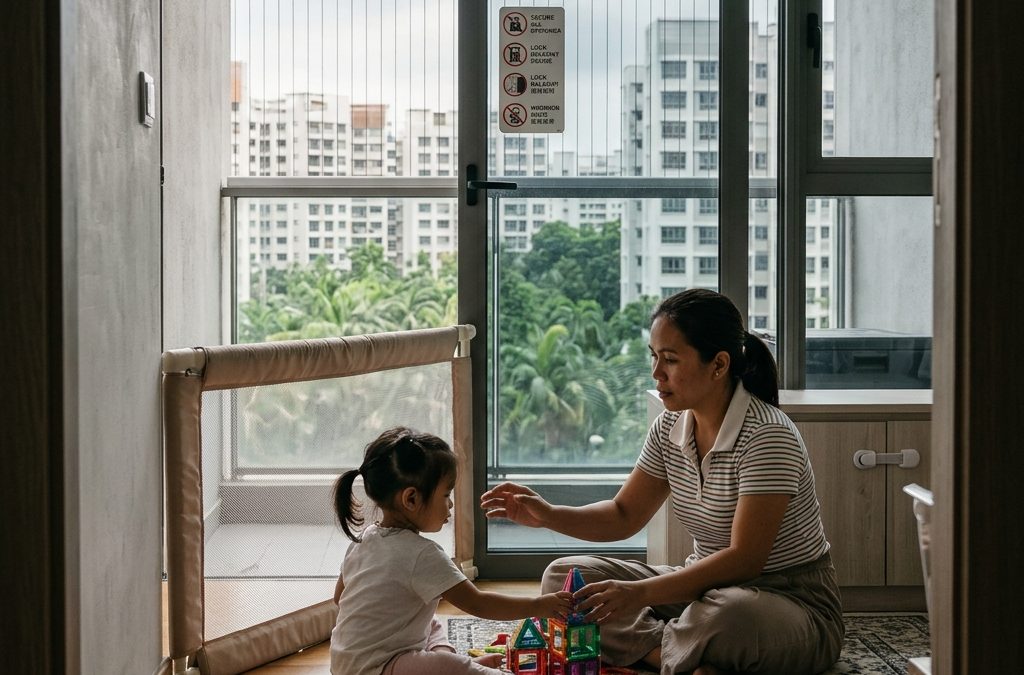
Living in a high-rise apartment is the standard reality for the vast majority of families in Singapore. Whether you reside in a modern HDB build or a soaring private condominium, the vertical nature of our city-state introduces specific safety considerations that differ significantly from landed properties. For working parents who rely on Migrant Domestic Workers (MDWs) for toddler care, the stakes of home safety are exceptionally high. A toddler’s natural curiosity combined with the physical environment of a high-floor unit requires more than just general supervision; it demands a structured, disciplined, and proactive safety protocol. At EELIT Agency, we recognize that the transition from hiring a helper to ensuring she is an expert in high-rise safety is a journey that requires clear communication and professional guidance. This guide provides an exhaustive look at how to manage toddler care in Singapore apartments, ensuring your home remains a sanctuary rather than a source of hidden hazards.
The Evolution of Safety: Understanding the 2026 MOM Regulatory Framework
The Ministry of Manpower (MOM) has consistently updated its guidelines to ensure the well-being of both the domestic worker and the family she serves. As we move toward 2026, the regulatory focus has sharpened on the MDW’s environment and her specific duties concerning vulnerable household members. The updated framework emphasizes that safety is a shared responsibility. Employers are legally obligated to provide a safe working environment, which includes ensuring that the helper is not tasked with high-risk activities while simultaneously supervising a toddler. For instance, the 2026 regulations strictly prohibit helpers from cleaning the exterior of window panes unless specific safety grilles are installed and locked. This is not just about the helper’s safety; it is about preventing situations where a toddler might be left unattended near an open window while the helper is occupied with cleaning tasks.
Furthermore, the MOM 2026 guidelines suggest that employers must conduct a formal orientation for their helpers that specifically covers the layout of the high-rise unit. This orientation must identify “no-go zones” and the location of all safety locks. At EELIT Agency, we integrate these regulatory requirements into our pre-deployment briefings. We ensure that every helper we place understands that her primary duty during active toddler hours is the child’s safety, which supersedes general housework. Under the new standards, the expectation is that an employer will provide clear, written instructions on what constitutes “active supervision” in the context of Singapore’s high-rise architecture.
Defining Active Supervision in a High-Rise Context
In the world of toddler care in Singapore, there is a significant difference between “being in the same house” and “active supervision.” A toddler can traverse a living room and reach a balcony edge in a matter of seconds. Therefore, we define active supervision as having the child within eyesight and earshot at all times, without the distraction of digital devices or heavy housework. In a high-rise setting, this means the helper must be positioned between the child and any potential exit point, such as the main door or the balcony entrance.
We advise employers to implement the “Arm’s Length Rule” for specific high-risk areas. If the toddler is on the balcony (even with grilles) or near the service yard, the helper should be no further than an arm’s length away. This proximity allows for an immediate physical intervention if the child attempts to climb or squeeze through a gap. Active supervision also involves the helper anticipating the child’s next move. If a toddler is pushing a chair toward a window, the helper must be trained to stop the action immediately rather than waiting for the child to climb. This proactive mindset is a core component of the training we provide at EELIT Agency, as it shifts the helper’s role from a passive observer to an active safety guardian.
The Geography of Hazard: Windows, Grilles, and Balconies
The most significant risk in any Singapore apartment is the fall from height. Toddlers are naturally inclined to climb to see the world outside. To mitigate this, the first protocol is the strict management of window grilles. Every window in the home must have grilles that are properly installed and, more importantly, kept locked. A common mistake in many households is leaving the grille key in the lock or leaving the grilles open for “ventilation.” For a household with a toddler, ventilation must never come at the expense of security. If the grilles must be opened for cleaning, the toddler must be placed in a separate, closed room or under the direct supervision of another adult.
The second protocol involves the placement of furniture. We often see beautiful interior designs where a sofa or a study desk is placed right against a window. In a toddler-centric home, this is a major safety violation. Furniture acts as a ladder. Employers must ensure that no “climbable” objects—including sofas, beds, toy boxes, or even large potted plants—are placed near windows or balcony railings. Our specialists at EELIT Agency often conduct home environment reviews with employers to identify these “climbing paths” that a toddler might use. We teach helpers to look at the room from a child’s eye level to identify what might look like a staircase to an adventurous two-year-old.
Kitchen and Service Yard Safety Protocols
The kitchen and service yard are the second most dangerous areas in a high-rise apartment. In many Singaporean homes, the service yard is where the washing machine is kept, and often, the windows there do not have the same heavy-duty grilles as the living room. The protocol here is simple: the kitchen and service yard should be off-limits to the toddler. We recommend the installation of sturdy, high-quality safety gates that a toddler cannot easily shake or unlatch. The helper must be instructed to keep these gates closed at all times, even when she is just stepping in for a second to check the laundry.
Inside the kitchen, the risks involve heat and chemicals. When the helper is cooking, the toddler should never be in the kitchen area. If the helper is alone with the child and must prepare a meal, the child should be secured in a high chair or a playpen within the helper’s line of sight but away from the stove. Furthermore, the storage of cleaning detergents—commonly kept under the sink in Singaporean flats—must be moved to high shelves or secured with magnetic child-safety locks. The high-rise environment often means compact living, which can lead to a cluttered kitchen; keeping this area organized and gated is essential for preventing accidental burns or poisoning.
Managing Digital Distractions and the Phone Policy
One of the most frequent concerns we hear from employers regarding toddler care in Singapore is the use of mobile phones. In a high-rise safety context, a five-minute distraction on a smartphone can lead to a lifetime of regret. We advocate for a “Duty-First Phone Policy.” This means that while the toddler is awake and under the helper’s care, the phone is kept in a designated area, such as the kitchen counter or the helper’s room, and is only used for emergencies or scheduled check-ins with the employer.
However, we also believe in a balanced approach. If the helper feels she is being monitored too harshly, it can lead to resentment and a lack of transparency. We encourage employers to allow their helpers “connected breaks” during the toddler’s nap time. By providing a clear window for phone usage, the helper is more likely to remain focused during the high-stakes hours of active toddler play. At EELIT Agency, we help bridge this communication gap by setting expectations during the hiring process, ensuring the helper understands that the phone policy is a safety protocol, not a punitive measure.
Daily Routine and Transition Management
Accidents often happen during transitions—when the helper is moving from one task to another, or when the family is leaving or entering the house. For example, when a helper is getting the toddler ready for a walk, the main door might be left ajar while she grabs the stroller. In a high-rise corridor, a toddler can quickly run toward the lift lobby or the stairs. The protocol for transitions must be “Child First, Task Second.” This means the child is secured (perhaps in the stroller with the brake on) before the door is even opened.
Another critical transition is the arrival of the “Uncle” or “Auntie” delivery person. The doorbell is a major distraction. Helpers should be trained to never leave a toddler alone in a room to answer the door. They should either bring the child with them to the door or ensure the child is in a safe, enclosed space like a playpen. These small, daily habits form the backbone of a successful safety strategy. By repeating these protocols daily, they become muscle memory for the helper, reducing the cognitive load of her job and making the home environment much safer.
Water Safety in the Bathroom
In many Singaporean households, it is common practice to collect water in pails or tubs for cleaning or as a backup. In a high-rise apartment where space is at a premium, these pails are often left in the bathroom. For a toddler, even a few inches of water in a pail represents a drowning hazard. The protocol for water safety is “Empty and Flip.” Once the helper is done using a pail, it must be emptied immediately and stored upside down. This prevents any accidental collection of water from a leaky tap or a shower head.
During bath time, the helper must be instructed to never leave the bathroom for any reason. If the phone rings or someone is at the door, the child must be taken out of the bath, dried, and moved with the helper. There are no exceptions to this rule. We emphasize this during our training sessions at EELIT Agency because it is a scenario where a helper might feel pressured to multitask, and our job is to give her the “permission” to ignore other tasks in favor of the child’s immediate safety.
Emergency Response and Communication
Despite all precautions, emergencies can happen. A well-prepared helper is the best defense in such a situation. Every household should have an emergency contact sheet prominently displayed, usually on the refrigerator. This list should include the parents’ office and mobile numbers, a trusted neighbor’s contact, and the number for the nearest 24-hour pediatric clinic. The helper must also be trained on how to use the home’s intercom system (if applicable) and how to call for an ambulance using 995.
We also recommend that employers invest in a basic first-aid course for their MDWs. Knowing how to handle a minor fall, a choking incident, or a small burn can prevent a situation from escalating. At EELIT Agency, we facilitate access to these training programs. Furthermore, we encourage an “Open Door Policy” for reporting near-misses. If the toddler almost climbed a chair or almost reached a handle, the helper should feel safe telling the employer without fear of immediate reprimand. This allows the family to fix the safety gap before an actual accident occurs. Building a culture of safety and transparency is far more effective than a culture of fear.
How EELIT Agency Supports Your Family’s Safety
Choosing a helper is one of the most important decisions a family will make. At EELIT Agency Pte. Ltd., we do not just “supply” labor; we match caregivers to the specific needs of Singaporean households. Our screening process is rigorous, focusing on the candidate’s temperament, her previous experience with children, and her ability to follow complex safety instructions. We understand that toddler care in Singapore requires a specific set of skills that go beyond general housekeeping.
Once a helper is selected, we provide comprehensive guidance to the employer on how to conduct the first week of orientation. We provide checklists that cover everything from window safety to the proper use of sterilizers and kitchen appliances. Our relationship with the family doesn’t end on the day of deployment. We offer ongoing support and mediation to ensure that the safety protocols are being followed and that the communication between the employer and the helper remains clear and respectful. We believe that a well-supported helper is a more vigilant caregiver, and a vigilant caregiver is the key to a safe and happy home.
Establishing a Partnership for Peace of Mind
The safety of a toddler in a high-rise apartment is not something that happens by accident; it is the result of intentional planning, clear communication, and consistent follow-through. By treating your domestic helper as a professional partner in your child’s upbringing, you create an environment where safety becomes a shared value. The protocols outlined in this guide—from furniture placement and window locks to phone policies and transition management—provide a roadmap for a secure household.
As the landscape of toddler care in Singapore continues to evolve with new MOM regulations and changing family needs, EELIT Agency remains committed to being your trusted partner. We provide the expertise and the high-caliber personnel needed to navigate the complexities of modern Singaporean parenting. By following these protocols and working closely with a licensed agency that understands the local context, you can enjoy the many benefits of high-rise living with the absolute peace of mind that your child is in safe, capable hands.
Connect with EELIT Placement Specialists
Speak directly with our senior placement consultants for personalized bio matching, MOM Work Permit processing, and household caregiving support across Singapore:
Corporate Headquarters Placement Consultation
Corporate HQ Priority WhatsApp: +65 9100 1610
Juliet (Senior Consultant): Chat with Juliet (+65 9168 2493) |
Joey (Senior Consultant): Chat with Joey (+65 8725 2891)
HQ Office Telephone (Hotline / Voice Call Only): +65 6320 3826
Islandwide Branch WhatsApp Lines
Orchard (Far East Shopping Centre): +65 9478 2786
Hougang: +65 8043 9823
Yishun: +65 8090 3168