
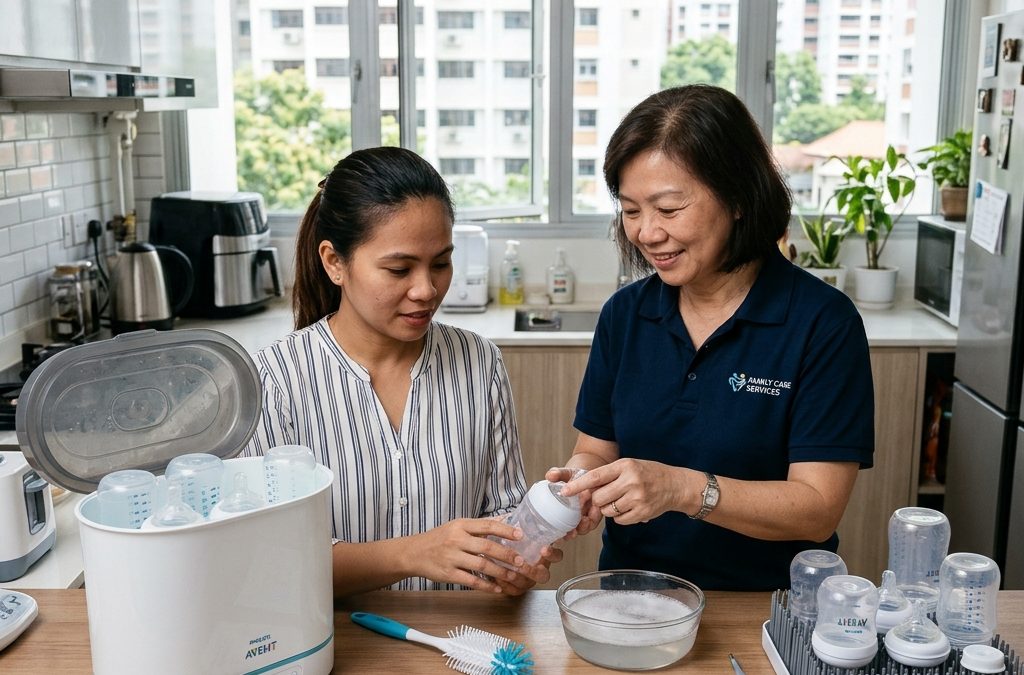
Welcoming a newborn into a Singaporean household is a joyous milestone that simultaneously introduces a complex set of responsibilities, particularly regarding health and sanitation. For many working parents, hiring an infant care maid is the most practical solution to balance professional demands with the meticulous needs of a baby. However, the transition requires more than just hiring help; it demands a rigorous training framework to ensure the helper understands the high standards of hygiene required in a tropical climate like Singapore. This guide provides an exhaustive roadmap for employers to train their domestic workers in bottle sterilization and infant hygiene, ensuring your child remains safe from preventable infections.
Understanding the 2026 MOM Framework for Specialized Caregivers
The Ministry of Manpower (MOM) has consistently evolved its regulations to ensure that Migrant Domestic Workers (MDWs) are better prepared for the specific needs of Singaporean families. Moving into 2026, there is an increased emphasis on specialized skill certification. While the basic Settling-In Programme (SIP) covers general safety, families hiring for infant care are now encouraged to look for helpers who have undergone accredited infant care modules. These modules focus on physiological needs, emergency responses, and most importantly, the prevention of communicable diseases through hygiene.
As an employer, you must recognize that your helper may come from a background where hygiene standards differ from Singapore’s medical recommendations. The 2026 guidelines suggest that employers should provide a structured orientation period. This is not just a suggestion but a practical necessity to align the helper’s actions with your family’s specific health requirements. At EELIT Agency, we advocate for a three-day intensive handover where the employer demonstrates every hygiene task twice before the helper performs it under supervision. This alignment ensures that the helper understands the “why” behind the “how,” which is the most effective way to prevent shortcuts in cleaning routines.
The Foundation of Infant Health: Hand Hygiene Protocols
The primary vector for bacteria and viruses in a household is the human hand. For an infant care maid, handwashing is not a periodic activity but a frequent, mandatory ritual. You must train your helper to wash her hands using the World Health Organization’s multi-step method, ensuring she cleans between fingers, under fingernails, and up to the wrists. This practice must be non-negotiable before touching the baby, before preparing any feed, and immediately after every diaper change.
In Singapore’s humid environment, bacteria multiply rapidly. It is helpful to place hand sanitizer dispensers in high-traffic areas like the changing table and the kitchen, but emphasize that sanitizer is not a replacement for soap and water when hands are visibly soiled. Furthermore, fingernails must be kept short and free of nail polish to prevent the accumulation of pathogens and to avoid accidental scratches on the baby’s delicate skin. Jewelry, such as rings and bracelets, should be removed during working hours as they can harbor germs and pose a physical risk to the infant.
Mastering Bottle Sterilization: Beyond Just Rinsing
Infants have immature immune systems, making them highly susceptible to gastroenteritis and other infections caused by contaminated feeding equipment. A critical part of training your infant care maid involves mastering the sterilization cycle. The process begins with thorough cleaning. Many helpers might assume that a quick rinse with water is sufficient if the bottle looks clean. You must explain that milk fats and proteins create a biofilm that requires warm soapy water and specialized bottle brushes to remove.
Start by instructing the helper to disassemble all bottle parts, including the teat, the ring, and the cap. Use a dedicated basin for baby items to avoid cross-contamination with oily adult dishes. Once scrubbed and rinsed, the items must be sterilized. In Singapore, most households use either Electric Steam Sterilizers or UV Sterilizers. If using a steam sterilizer, ensure the helper knows the correct water levels to prevent the machine from running dry. If using a UV sterilizer, emphasize that items must be completely dry before they go in, and they must be placed facing the light source without overlapping, as UV light only kills bacteria on surfaces it can reach.
Storage after sterilization is equally important. Once the cycle is finished, bottles should remain in the closed sterilizer until they are needed, or they should be assembled with clean hands and stored in a dust-free container. Instruct your helper to never dry the inside of a bottle with a kitchen towel, as this introduces new bacteria into a sterile environment. Air-drying on a dedicated, clean rack is the only acceptable method if the sterilizer does not have a built-in drying function.
Safe Handling of Expressed Breast Milk and Formula
For breastfeeding mothers returning to work, the helper’s role in managing expressed breast milk (EBM) is vital. Breast milk is “living” food and requires careful temperature management. Train your helper to follow the “first-in, first-out” rule by labeling every storage bag with the date and time of expression. EBM should be thawed in the refrigerator overnight or by placing the bag in a bowl of warm water. It must never be microwaved, as this creates hot spots that can burn the baby’s mouth and destroys the milk’s nutritional properties.
If your baby is formula-fed, the protocol shifts toward precision and water safety. In Singapore, while tap water is generally safe, it is standard practice to use cooled, boiled water for infant formula. Ensure your helper understands the exact ratio of powder to water. Adding too much powder can lead to dehydration and constipation, while too little can result in malnutrition. Hygiene also extends to the formula tin itself; the scoop should be kept dry, and the lid must be closed tightly after every use to prevent moisture and insects from entering.
Diapering and Skin Care Hygiene
The diaper changing station is a high-risk area for the spread of fecal-oral contaminants. Your helper must be trained to keep this area organized and sanitized. The protocol should involve gathering all supplies—diaper, wipes, cream, and a change of clothes—before bringing the baby to the table to ensure the child is never left unattended. During the change, the helper should wipe from front to back, especially for baby girls, to prevent urinary tract infections.
After disposing of the soiled diaper in a lidded bin, the changing mat must be wiped down with a baby-safe disinfectant. The helper must then wash her hands thoroughly before returning to any other task. Additionally, infant skin is incredibly thin and prone to rashes. Instruct your helper on the correct application of barrier creams and the importance of ensuring the baby’s skin is completely dry before putting on a new diaper. In Singapore’s heat, “air time” without a diaper can also be beneficial, and your helper should be trained to manage these moments to prevent heat rash and diaper dermatitis.
Maintaining a Sanitize Nursery Environment
The baby’s environment extends beyond the bottle and the diaper. An infant care maid must maintain a schedule for cleaning the nursery. Dust is a significant trigger for allergies and respiratory issues in Singapore, so wet-dusting (using a damp cloth to trap dust rather than spreading it) is the preferred method. Bed linens, including cot sheets and mattress protectors, should be changed at least twice a week or immediately if soiled by spit-up or leaks.
Toys, especially those that the baby puts in their mouth, require regular sanitization. Hard plastic toys can be washed with mild baby soap, while plush toys should be laundered in a mesh bag using hypoallergenic detergent. You should also establish a protocol for “clean zones” in the house. For example, shoes should never be worn in the nursery, and the helper should change her clothes if she has been out in the humid air or cooking in the kitchen before she handles the baby. This reduces the transfer of outdoor pollutants and allergens to the infant.
Managing Cross-Contamination in Multi-Generational Homes
Many Singaporean households include grandparents or extended family members. This can sometimes lead to conflicting views on hygiene. A specialized infant care maid must be empowered to follow the parents’ instructions regarding sterilization and hygiene, even if elders suggest traditional methods that may not align with modern medical advice. For instance, an older family member might suggest rinsing a pacifier under the tap if it falls, but your helper must know that it needs to be sterilized or replaced with a fresh one.
Cross-contamination in the kitchen is another area of concern. If the helper is also responsible for cooking for the adults, there must be a clear separation between raw food preparation and baby bottle preparation. Ideally, these tasks should happen at different times. If she has just handled raw meat or seafood, a simple hand wash is not enough before touching the baby’s equipment; she should ideally change her apron and perform a surgical-grade hand wash to ensure no pathogens are transferred.
Communication and Observation: The Helper’s Daily Log
A well-trained helper is also a keen observer. Hygiene and health are closely linked to the baby’s output and behavior. We recommend that every employer provides a daily logbook for the helper to record feeding times, amounts, diaper changes (noting the consistency and color of stools), and any skin changes like rashes or dryness. This logbook is a vital communication tool that helps you monitor the baby’s health while you are at work.
Encourage your helper to speak up if she notices anything unusual. For example, if the baby’s skin appears flushed or if there is a persistent odor coming from the umbilical cord stump (for newborns), she should report it immediately. Training her to be your eyes and ears ensures that hygiene issues are caught before they turn into medical problems. This level of proactive care is what distinguishes a general domestic worker from a specialized infant care maid.
How EELIT Agency Supports Your Family’s Journey
At EELIT Agency Pte. Ltd., we understand that the safety of your newborn is your highest priority. As a MOM-licensed agency, we don’t just facilitate the hiring process; we focus on the long-term success of the placement. Our selection process for infant care maids involves rigorous screening for candidates who demonstrate a natural aptitude for caregiving and a high capacity for learning medical-grade hygiene protocols.
We provide comprehensive orientation for our helpers, ensuring they are familiar with the specific expectations of Singaporean households. Our support extends beyond the first day; we offer guidance to employers on how to structure their home-based training and provide resources to help bridge communication gaps. By choosing a helper through EELIT, you are gaining a partner in your child’s upbringing. We ensure that your helper is prepared to maintain the sterile, safe, and nurturing environment your baby deserves, giving you the peace of mind to focus on your career and your family life.
In conclusion, the health of your infant relies on the consistency of the hygiene protocols practiced by your helper. By investing time in thorough training, emphasizing the science behind sterilization, and maintaining open lines of communication, you create a protective shield around your child. With the right training and a specialized helper from EELIT Agency, you can navigate the challenges of new parenthood with confidence, knowing that your baby’s wellbeing is in capable, clean hands.
Connect with EELIT Placement Specialists
Speak directly with our senior placement consultants for personalized bio matching, MOM Work Permit processing, and household caregiving support across Singapore:
Corporate Headquarters Placement Consultation
Corporate HQ Priority WhatsApp: +65 9100 1610
Juliet (Senior Consultant): Chat with Juliet (+65 9168 2493) |
Joey (Senior Consultant): Chat with Joey (+65 8725 2891)
HQ Office Telephone (Hotline / Voice Call Only): +65 6320 3826
Islandwide Branch WhatsApp Lines
Orchard (Far East Shopping Centre): +65 9478 2786
Hougang: +65 8043 9823
Yishun: +65 8090 3168