
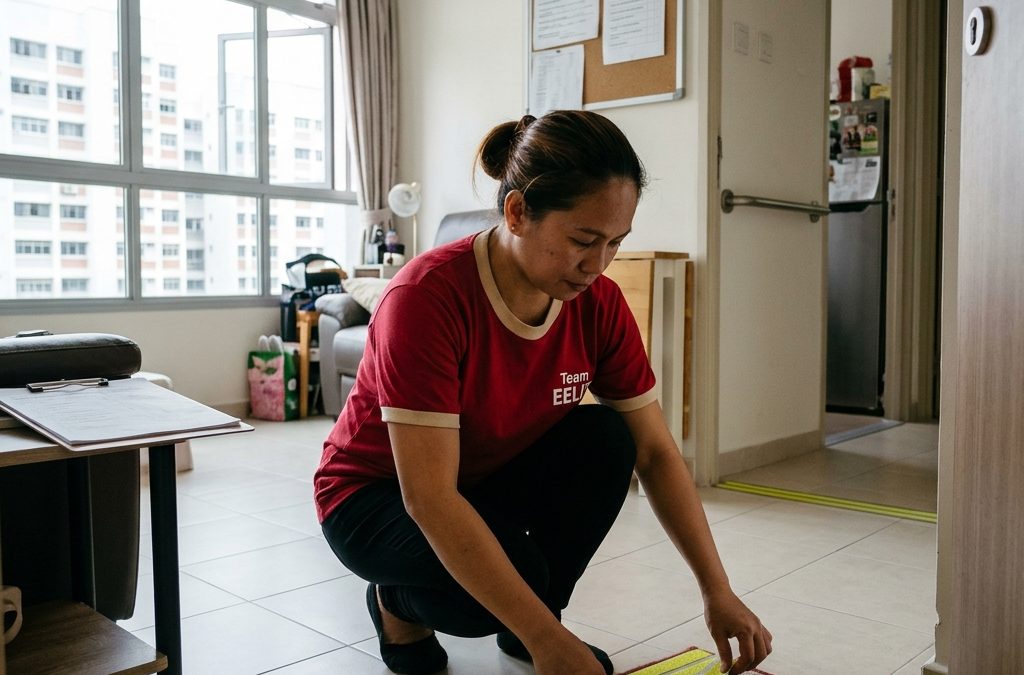
Living in a high-rise HDB flat offers convenience and community, but for an elderly family member experiencing sensory decline, these vertical homes present a unique set of hidden dangers. As Singapore moves toward a “Super-Aged” society by 2026, the Ministry of Manpower (MOM) and the Building and Construction Authority (BCA) have increasingly emphasized the importance of specialized training for domestic helpers who act as the primary caregivers in these environments. Ensuring Fall Prevention SG standards are met is no longer just about removing trip hazards; it is about understanding how a senior’s changing perception of sight, sound, and balance transforms a familiar home into a potential minefield. At EELIT Agency, we recognize that a helper’s ability to manage these risks is the cornerstone of aging-in-place successfully.
The Biological Reality of Sensory Decline in the HDB Context
To effectively manage fall risks, a domestic helper must first understand that an elderly person does not see or hear the world the same way a younger person does. Sensory decline is often gradual and invisible. For instance, the common HDB layout often features different floor textures between the living room and the kitchen, or a slight raised threshold at the bathroom entrance. To a senior with diminished depth perception, these transitions can appear as a flat surface or a deep void, leading to missteps. Visual acuity often drops, making it harder to distinguish between the white edge of a toilet bowl and the white tiles of the bathroom wall.
Hearing loss also plays a significant role in fall hazards. If a senior cannot hear the hum of a refrigerator or the sound of someone approaching from behind, they may startle easily. A sudden jerk or turn to see who is speaking can cause a loss of balance, especially if the senior suffers from orthostatic hypotension—a drop in blood pressure when standing up quickly. Furthermore, the loss of proprioception, which is the body’s ability to sense its position in space, means the senior might not realize their foot is too close to the edge of a rug or a piece of furniture. A helper trained by EELIT is taught to look for these subtle signs of decline before an accident occurs.
Upcoming 2026 MOM Regulatory Framework and Safety Standards
Singapore’s regulatory landscape for migrant domestic workers is shifting toward higher specialization. By 2026, there is an expected push for mandatory specialized caregiving modules for helpers looking after seniors with high dependency levels. This framework emphasizes that Fall Prevention SG is a shared responsibility between the employer and the agency. Employers are now encouraged to conduct regular home safety audits, and domestic helpers are expected to maintain a daily log of the senior’s mobility status. This proactive stance helps in identifying when a senior might need a walking aid or when the home environment requires further modifications like grab bars or non-slip coatings.
EELIT Agency stays ahead of these regulations by ensuring our eldercare-focused helpers are briefed on the latest safety protocols. We emphasize that a helper is not just a pair of hands but an observant guardian. Under the 2026 guidelines, the focus moves from reactive care to preventive monitoring. This means a helper must be able to identify if a senior’s gait has changed or if they are squinting more than usual, as these are leading indicators of an impending fall. Staying compliant with these evolving standards ensures that your household remains a safe sanctuary for your elderly loved ones.
The Kitchen and Bathroom: Managing the High-Risk Wet Zones
The bathroom is statistically the most dangerous room in an HDB flat. The combination of hard surfaces, moisture, and tight spaces makes it the primary location for serious injuries. A domestic helper must implement a strict “Dry Floor Policy.” This involves more than just mopping; it requires the use of high-absorbency mats with rubberized backing that do not slide. The helper should ensure that the senior never enters the bathroom alone if they are prone to dizziness. Lighting in the bathroom must be significantly brighter than in the rest of the house to compensate for the senior’s reduced light sensitivity.
In the kitchen, the risks are similar but often complicated by the presence of hot liquids and sharp objects. In many HDB flats, the kitchen serves as a thoroughfare to the service yard. If the helper is washing clothes or cooking, the floor can quickly become slippery. A professional caregiving protocol dictates that the senior should be discouraged from entering the kitchen during heavy chores. If the senior wishes to help with meal preparation, the helper should set up a seated station at the dining table rather than having the senior stand at the counter for extended periods, which causes fatigue and increases the chance of a stumble.
Daily Morning Safety Checklist for Domestic Helpers
1. Check the senior’s footwear as soon as they wake up. Ensure they are wearing well-fitted slippers with non-slip soles rather than just socks, which are incredibly slippery on polished HDB tiles.
2. Perform a “Clear Path” sweep of the living room and corridors. Remove any newspapers, mail, or plastic bags that may have accumulated on the floor. In HDB flats, we often store items along the walls, but these can easily migrate into the walking path.
3. Monitor the senior as they transition from a lying to a sitting position, and then to a standing position. Instruct the helper to wait at least sixty seconds between each movement to allow the senior’s blood pressure to stabilize.
4. Verify that all night lights are turned off and that curtains are opened to allow maximum natural light into the flat. Shadows can be misinterpreted as obstacles by seniors with cataracts or glaucoma.
5. Test the stability of any walking frames or canes. Check the rubber tips (ferrules) for wear and tear. If the rubber is smooth, it will not grip the floor properly and must be replaced immediately.
Afternoon and Evening Environmental Maintenance
As the day progresses, “Sundowning” or increased confusion can occur in seniors with cognitive decline, which significantly increases fall risks. During the late afternoon, the helper should ensure that the flat is well-lit before the sun sets. The transition from natural daylight to artificial light can be disorienting. Dimly lit corners in a typical HDB layout can hide low-lying furniture like coffee tables or footstools. The helper should ensure all walkways are wide enough for the senior to pass through without having to turn sideways, which challenges their balance.
The evening routine should include a final check of the bathroom floor to ensure it is completely dry before the senior’s final trip to the toilet before bed. Many falls happen late at night when the senior is drowsy and attempting to navigate to the bathroom in the dark. EELIT recommends the installation of motion-sensor lights along the path from the bedroom to the bathroom. The helper should also ensure that the senior’s phone or an emergency bell is within arm’s reach of the bed. Small adjustments like these create a “fail-safe” environment that reduces the mental load on both the senior and the caregiver.
Communication Strategies for Hearing and Vision Impairment
Effective fall prevention is also about how a helper communicates. If a senior has hearing loss, they may not hear a helper’s warning about a wet floor or an obstacle. A helper should be trained to always make eye contact before speaking. They should use a lower pitch of voice rather than shouting, as high-pitched sounds are often the first to be lost in age-related hearing decline. Using clear hand gestures to point out hazards can be a lifesaver. This visual reinforcement ensures the message is received even if the senior’s hearing aids are not in use.
For seniors with vision impairment, the helper should act as a “human GPS.” Instead of saying “be careful,” the helper should give specific directions like “there is a small step in two paces” or “we are turning left into the kitchen now.” In HDB flats where space is at a premium, moving a piece of furniture even by a few inches can confuse a senior who relies on muscle memory and touch to navigate. The helper must be instructed never to rearrange the furniture without informing the senior and guiding them through the new layout multiple times.
Addressing the Hazard of Clutter and Corridor Obstructions
HDB living often involves the use of common corridors for shoe racks, potted plants, and bicycles. While this is part of the local culture, it poses a severe risk if the senior needs to exit the flat quickly or if they enjoy taking short walks outside for fresh air. A helper should be responsible for keeping the immediate area outside the front door clear. Even a stray pair of shoes can cause a senior to trip when they are stepping over the threshold. The transition between the unit’s flooring and the common corridor’s tiles can often be uneven, requiring the helper’s physical support during the transition.
Inside the flat, the accumulation of “stuff” is a silent threat. Many Singaporean households are multi-generational, meaning the home is filled with items belonging to children and grandchildren. Toys on the floor, charging cables for laptops, and shopping bags are common sights. A core duty of a domestic helper specialized in eldercare is “constant vigilance over the floor landscape.” They must be empowered by the employer to clear away items belonging to other family members if they pose a risk to the senior. At EELIT, we teach our helpers that “a clear floor is a safe floor.”
Emergency Protocol: What to Do if a Fall Occurs
Despite all precautions, falls can still happen. The way a domestic helper responds in the first sixty seconds is critical. First, they must stay calm and keep the senior calm. They should not immediately try to lift the senior, as this can worsen injuries like hip fractures or spinal trauma. The helper should check for consciousness, bleeding, or obvious deformities. If the senior is in pain or cannot move, the helper must call 995 immediately and then notify the employer.
If the senior appears unhurt, the helper should use the “Chair Method” to help them up. This involves bringing a sturdy chair close to the senior, having them roll onto their side and then onto their hands and knees, and finally using the chair for support to slowly rise. The helper should never pull on the senior’s arms, as elderly skin is thin and joints are fragile. Following any fall, even a minor one, the helper should document the incident and the circumstances leading up to it. This information is vital for the family doctor to determine if the fall was caused by a medical issue like a stroke or a change in medication.
How EELIT Agency Supports Families in Fall Prevention
Selecting a domestic helper who is capable of managing these complex needs is a daunting task for many families. At EELIT Agency, we go beyond basic biodata. We screen our candidates for their patience, observational skills, and previous experience in eldercare. We understand that a helper working in an HDB flat needs to be particularly adept at space management and hazard identification. Our orientation process includes practical discussions on Fall Prevention SG, ensuring that when a helper arrives at your home, she is already thinking about the safety of your elderly parents.
We also provide ongoing support for employers. If your senior’s condition changes—perhaps after a hospital discharge or a new diagnosis—we can provide guidance on how to retrain your helper for these new challenges. We believe that a successful placement is a partnership between the agency, the employer, and the helper. By focusing on specialized training and a deep understanding of the Singaporean HDB environment, EELIT Agency helps families create a safe, dignified, and loving home for their seniors to age in peace.
Final Thoughts on Building a Culture of Safety
Managing sensory decline and fall hazards is not a one-time task but a continuous commitment. It requires a domestic helper who is proactive rather than reactive, and an employer who supports the necessary home modifications and training. In the compact environment of a high-rise HDB flat, the margin for error is small. However, with the right protocols, specialized help from EELIT Agency, and a focus on the unique sensory needs of the elderly, the risk of falls can be dramatically reduced. By prioritizing Fall Prevention SG, you are not just preventing an injury; you are preserving the independence and quality of life for your loved ones in their golden years.
Connect with EELIT Placement Specialists
Speak directly with our senior placement consultants for personalized bio matching, MOM Work Permit processing, and household caregiving support across Singapore:
Corporate Headquarters Placement Consultation
Corporate HQ Priority WhatsApp: +65 9100 1610
Juliet (Senior Consultant): Chat with Juliet (+65 9168 2493) |
Joey (Senior Consultant): Chat with Joey (+65 8725 2891)
HQ Office Telephone (Hotline / Voice Call Only): +65 6320 3826
Islandwide Branch WhatsApp Lines
Orchard (Far East Shopping Centre): +65 9478 2786
Hougang: +65 8043 9823
Yishun: +65 8090 3168