
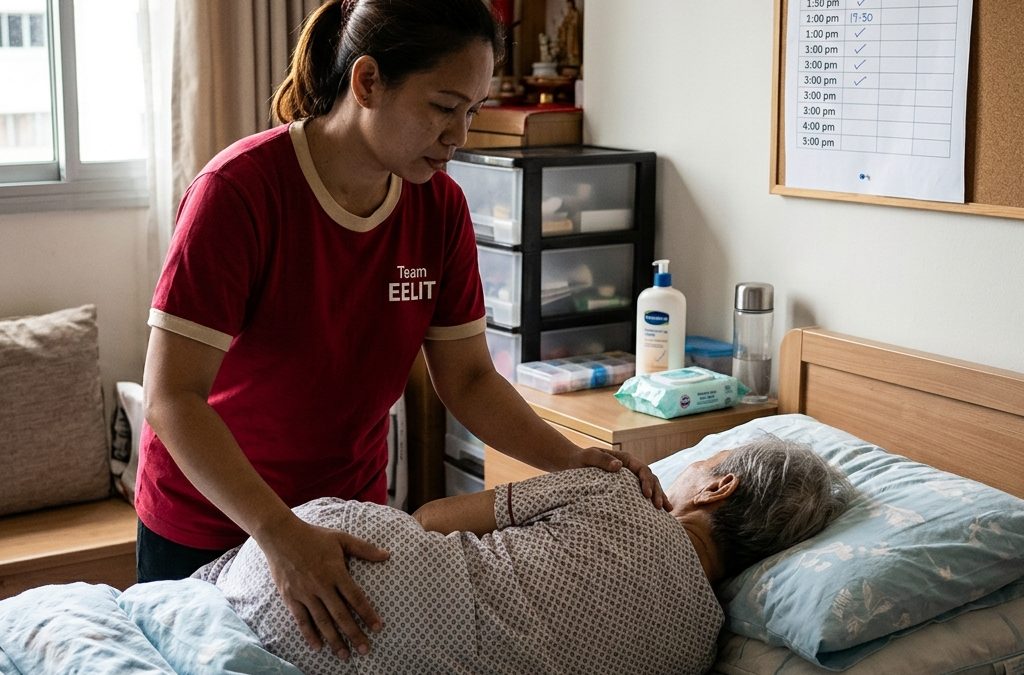
Caring for a bedridden elderly family member requires more than just compassion; it demands a clinical level of precision and a disciplined routine. In Singapore’s rapidly aging society, many households rely on Migrant Domestic Workers (MDWs) to provide this round-the-clock care. However, the physical and emotional toll of managing a bedridden senior is significant, particularly when it comes to the constant threat of pressure sores. At EELIT Agency, we understand that pressure sore prevention is the cornerstone of effective home care. This guide serves as an authoritative manual for Singaporean employers to train their helpers, set up a professional-grade turning schedule, and comply with the evolving Ministry of Manpower (MOM) regulations regarding specialized caregiving duties.
Understanding the Biology of Pressure Sores in the Singapore Context
Pressure sores, also known as decubitus ulcers or bedsores, are localized injuries to the skin and underlying tissue, usually over a bony prominence. They happen because of sustained pressure that cuts off blood circulation. For a senior living in an HDB flat or a condo in Singapore’s humid climate, the risk is compounded. Humidity causes the skin to soften through perspiration, making it more susceptible to friction and shear when a senior is moved in bed.
When blood flow is restricted for more than two hours, tissue begins to die. This starts as a persistent redness that does not turn white when pressed. If left unmanaged, it can progress into deep, open wounds that reach the bone, leading to life-threatening infections like sepsis. For the domestic helper, preventing these sores is far easier than treating them. Prevention is a proactive daily mission that requires a keen eye and a strict adherence to a clock-based routine.
The MOM Framework and 2026 Caregiving Standards
The Ministry of Manpower (MOM) has been steadily increasing the requirements for helpers who perform specialized caregiving. By 2026, the landscape of domestic employment in Singapore will place a much higher emphasis on formal competency. MOM and the Agency for Integrated Care (AIC) are encouraging employers to ensure their MDWs are properly trained in physical maneuvers, such as lifting and positioning, to prevent workplace injuries for the helper and physical harm to the employer.
Employers must recognize that under the 2026 framework, a helper’s wellbeing is directly tied to the quality of care they provide. A helper who is exhausted or lacks proper training is more likely to skip a turning cycle or use incorrect lifting techniques that cause skin tears. EELIT Agency stays ahead of these regulations by ensuring our caregiving-focused helpers have undergone preliminary training that aligns with the requirements for the Caregivers Training Grant (CTG). We advocate for a clear division of labor in multi-generational households so that the helper can prioritize medical routines over general housework during critical hours.
Establishing the 24-Hour Gold Standard Turning Schedule
A turning schedule is not a suggestion; it is a medical necessity. The industry standard for a bedridden patient is to change their position at least every two hours. This prevents any single area of the body from bearing the full weight of the torso for too long. For a domestic helper, this schedule must be documented in a physical logbook to ensure accountability and to provide data for doctors during check-ups.
1. 08:00 AM: Position the senior on their left side, supported by pillows behind the back and between the knees.
2. 10:00 AM: Move the senior to a supine position (lying on the back) with a small pillow under the calves to “float” the heels off the mattress.
3. 12:00 PM: Position the senior on their right side, ensuring the ear and shoulder are not folded or crushed.
4. 02:00 PM: Return to the supine position, perhaps slightly elevating the head of the bed to 30 degrees for feeding or interaction, but no higher, as this increases pressure on the sacrum.
5. 04:00 PM: Left side positioning again, checking for any skin redness during the transition.
6. 06:00 PM: Supine position with a focus on cleaning any perspiration that has accumulated in skin folds.
7. 08:00 PM: Right side positioning for the initial night-time sleep phase.
8. 10:00 PM and throughout the night: The two-hour rule remains critical, although some specialized pressure-relieving mattresses may allow for slightly longer intervals if approved by a doctor. However, for most seniors, the helper must maintain the cycle until the morning.
The 30-Degree Lateral Tilt Technique
A common mistake made by untrained helpers is turning the senior directly onto their hip bone at a 90-degree angle. This actually creates a new pressure point on the trochanter (the bony part of the outer hip). Instead, EELIT Agency trains helpers in the 30-degree lateral tilt. This involves tilting the body to a 30-degree angle and supporting the back with a wedge or pillow so the weight is distributed across the fleshy part of the buttock rather than directly on the hip bone.
During these turns, the helper must also practice “offloading.” This means ensuring that the ankles and knees do not touch each other by placing a pillow in between. They must also ensure that the heels are always suspended. The skin on the heels is very thin, and even a few hours of contact with a firm mattress can cause a Stage 1 pressure sore.
Daily Skin Assessment Protocols for Domestic Helpers
Prevention requires the helper to act as a daily medical observer. Every time the senior is turned, the helper should perform a quick skin check. The areas to watch most closely are the tailbone (sacrum), the hips, the heels, the elbows, and the back of the head. The helper should look for any changes in color, temperature, or texture.
The “Blanching Test” is a critical skill. If the helper sees a red patch, they should press it firmly with a finger. In healthy skin, the area will turn white (blanch) and then turn red again once the finger is removed. If the area stays red and does not turn white, it is a sign that a pressure sore is forming. At this point, the helper must be instructed to never rub the area, as rubbing can cause more tissue damage. Instead, they must ensure no pressure is put on that spot at all and inform the employer immediately.
Nutrition and Hydration: The Internal Defense
Pressure sore prevention is not just an external job. A senior who is malnourished or dehydrated has skin that is papery, thin, and easily damaged. In the Singapore context, many seniors may have dietary restrictions due to diabetes or kidney issues, making nutrition more complex. The domestic helper must ensure that the senior receives adequate protein and vitamins, which are the building blocks of skin repair.
Hydration is equally important. Dehydrated skin loses its elasticity, making it more prone to “shearing.” Shearing happens when the skin stays in one place (like sticking to a bedsheet) while the body slides down, tearing the underlying blood vessels. The helper should encourage small, frequent sips of water throughout the day, unless the doctor has ordered a fluid restriction. EELIT Agency advises employers to provide their helpers with a hydration log to track exactly how much fluid the senior is consuming.
The Impact of Incontinence on Pressure Sore Prevention
Moisture is the enemy of skin integrity. For bedridden seniors who use adult diapers, the risk of “Incontinence Associated Dermatitis” (IAD) is high. When skin is exposed to urine or feces, the pH balance is disrupted, and the skin begins to break down. This creates the perfect environment for a pressure sore to start.
Helpers must be trained to change diapers immediately upon soiling. They should use pH-balanced skin cleansers rather than harsh soaps, and they should apply a moisture barrier cream (such as those containing zinc oxide or petrolatum) to protect the skin from bodily fluids. When cleaning the senior, the helper must use a “pat dry” motion rather than a “rub dry” motion to avoid friction damage. This level of meticulous care is what separates an average domestic worker from a skilled caregiver.
Essential Equipment for a Safe Home Care Environment
A helper can only do so much without the right tools. For a bedridden senior in Singapore, the home setup should include specific items that make pressure sore prevention possible. EELIT Agency recommends that families look into the following equipment, much of which can be subsidized by the Seniors’ Mobility and Enabling Fund (SMF) if the senior meets the criteria.
First, an alternating pressure air mattress is vital. These mattresses have individual air cells that inflate and deflate in a cycle, constantly changing the pressure points on the body. However, these mattresses are a supplement to turning, not a replacement for it. Second, high-quality draw sheets should be used. These are small sheets placed across the middle of the bed that allow the helper to slide and reposition the senior without pulling on their skin. Third, positioning wedges made of high-density foam are more effective than standard pillows for maintaining the 30-degree tilt.
Managing the Helper’s Workload and Mental Health
A turning schedule that runs every two hours, 24 hours a day, is impossible for one person to manage indefinitely. In Singapore, many families expect their helper to manage the household and provide this level of intensive care. This is a recipe for burnout and, eventually, a decline in the quality of care for the senior. Under MOM guidelines, helpers must have adequate rest to perform their duties safely.
Families should consider a “tag-team” approach. During the day, the helper manages the turning and care. In the evening or on the helper’s rest day, family members or a professional home nurse should take over. If the helper is required to wake up every two hours at night, they must be allowed to sleep during the day. EELIT Agency works with employers to create a sustainable “Duty of Care” plan that balances the senior’s needs with the helper’s physical limits. A well-rested helper is more observant, more patient, and less likely to make mistakes that lead to pressure ulcers.
How EELIT Agency Supports Singaporean Families
At EELIT Agency, we do not just provide a domestic helper; we provide a caregiving partner. Our role starts with a thorough assessment of your family’s specific needs. We screen candidates for their experience with bedridden patients, their physical strength for safe transfers, and their ability to follow complex medical instructions. We emphasize the importance of communication, ensuring that the helper feels comfortable reporting skin changes to the employer without fear of being blamed.
We also provide guidance on the various grants available in Singapore, such as the Home Caregiving Grant (HCG), which can help offset the costs of hiring a specialized helper or purchasing medical equipment. Our goal is to create a professional care environment within your home, where the senior is protected from the pain of pressure sores and the helper is supported in their challenging role.
Practical Scenarios and Troubleshooting
Consider a scenario where the senior is resistant to being turned. Some seniors with dementia may become agitated when moved. The helper needs to be trained in gentle communication techniques, explaining what they are doing in a calm voice. If the senior is in pain, the timing of the turn should be coordinated with their pain medication schedule. If a helper notices a Stage 1 sore (non-blanchable redness) on a Sunday while the family is out, they should know exactly who to call and how to adjust the turning schedule to keep all weight off that specific area until a professional can assess it.
Another scenario involves the helper’s own physical safety. If a senior is heavy, the helper should never try to turn them alone if it causes strain. We teach the use of the “log-roll” technique and the use of sliding sheets to minimize the physical effort required. This protects the helper from back injuries and ensures the senior is moved smoothly without skin friction.
Conclusion: The Path to Proactive Care
Managing a bedridden senior is a journey that requires a structured approach. Pressure sore prevention is the most important task in this journey, as these wounds are far easier to prevent than they are to heal. By implementing a strict turning schedule, ensuring proper nutrition, and utilizing the right equipment, Singaporean families can provide their loved ones with a high quality of life at home. EELIT Agency is committed to being your partner in this process, providing trained helpers and the professional advice needed to navigate the complexities of home caregiving in Singapore. With the right training and a disciplined routine, the risk of pressure ulcers can be managed, allowing your family to focus on making meaningful memories with your loved ones.
Connect with EELIT Placement Specialists
Speak directly with our senior placement consultants for personalized bio matching, MOM Work Permit processing, and household caregiving support across Singapore:
Corporate Headquarters Placement Consultation
Corporate HQ Priority WhatsApp: +65 9100 1610
Juliet (Senior Consultant): Chat with Juliet (+65 9168 2493) |
Joey (Senior Consultant): Chat with Joey (+65 8725 2891)
HQ Office Telephone (Hotline / Voice Call Only): +65 6320 3826
Islandwide Branch WhatsApp Lines
Orchard (Far East Shopping Centre): +65 9478 2786
Hougang: +65 8043 9823
Yishun: +65 8090 3168