
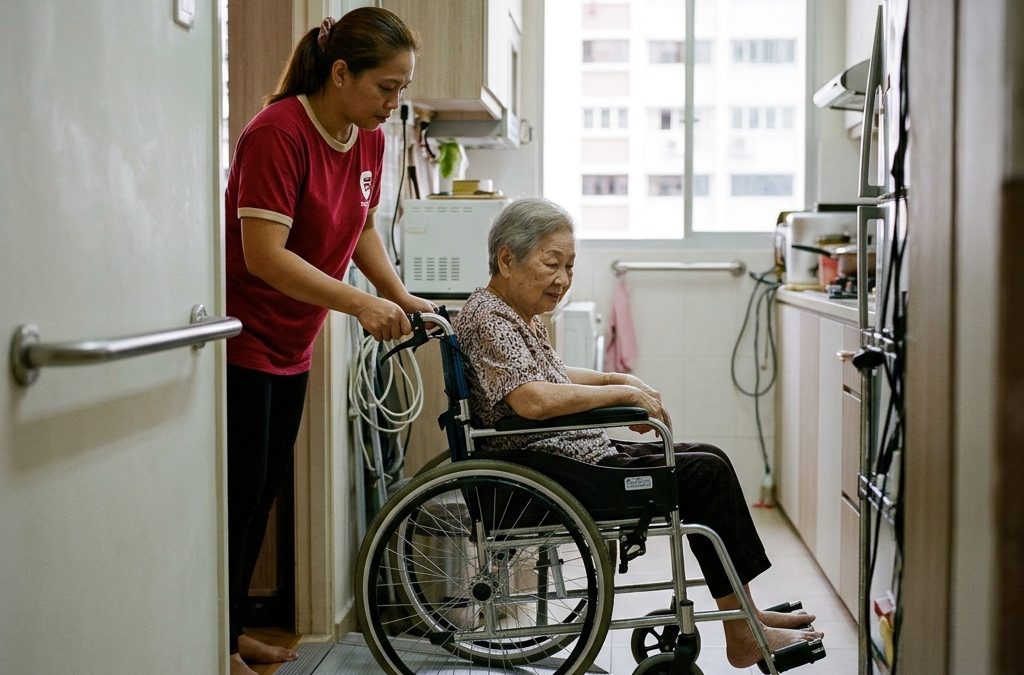
As Singapore transitions toward a “super-aged” society, the role of the Migrant Domestic Worker (MDW) has evolved from general housekeeping to specialized home nursing. For many local families living in HDB flats, bringing home a wheelchair-bound elderly family member requires more than just a ramp; it requires a complete overhaul of household protocols and a deep commitment to physical safety for both the senior and the helper. At EELIT Agency, we recognize that wheelchair safety is not a static list of rules but a dynamic skill set that involves understanding HDB architectural constraints, mastering body mechanics, and staying ahead of the Ministry of Manpower’s tightening regulations for specialized caregiving.
The Evolving Regulatory Framework: MOM 2026 and Beyond
The Ministry of Manpower (MOM) and the Agency for Integrated Care (AIC) have signaled significant shifts in how specialized caregiving is handled in Singapore. By 2026, the industry expects more stringent requirements regarding the competency of MDWs who are tasked with caring for non-ambulant or semi-ambulant employers. Currently, the Caregiving Training Grant (CTG) allows families to offset the cost of training their helpers, but the future landscape will likely mandate specific certification hours for those handling wheelchair-dependent seniors. This shift is designed to reduce the high incidence of workplace injuries among domestic workers, particularly musculoskeletal disorders caused by improper lifting. For employers, this means that ensuring your helper is trained in wheelchair safety is no longer a choice—it is a core responsibility that impacts your legal standing and insurance liabilities.
EELIT Agency has already begun integrating these forward-looking standards into our placement process. We emphasize that families must view the helper as a skilled technician of the home. If a helper is injured while performing a transfer because she was not provided with the right training or equipment, the household faces a double crisis: a loss of care for the elderly and a complicated medical and legal situation with the domestic worker. Proper adherence to the 2026 standards involves regular skill audits and ensuring that the helper’s work permit reflects her actual caregiving duties, protecting the family under the Work Injury Compensation Act (WICA).
Auditing the Singapore HDB Layout for Wheelchair Access
The standard Singapore HDB flat, while functional, presents specific obstacles for wheelchair mobility. Narrow doorways, sudden floor level changes, and cluttered corridors are the primary causes of accidents. To ensure wheelchair safety, the first step is a physical audit of the home. Most 3-room and 4-room flats have a narrow hallway leading to the bedrooms. If the wheelchair’s width is too close to the doorframe’s width, the risk of hand injuries or “pinching” is high. We recommend installing offset hinges on bedroom doors, which allow the door to swing completely clear of the opening, providing an extra inch of crucial space.
The “HDB step” is another significant hurdle. Many older flats have a 2-inch to 4-inch drop into the kitchen or the bathroom. For a helper, pushing a wheelchair over these bumps repeatedly can cause long-term strain on her wrists and back. It also poses a tipping risk for the elderly person. Installing rubber threshold ramps is a simple, cost-effective fix that eliminates the need for the helper to “pop a wheelie” to enter a room. Furthermore, under the HDB Enhancement for Active Seniors (EASE) program, many families are eligible for subsidized grab bars and slip-resistant floor treatments. These modifications are essential for a helper to safely guide a senior from a wheelchair to a stationary seat or toilet.
The Mechanics of Safe Patient Transfer
The most dangerous moment in a caregiving routine is the transfer—moving the senior from the bed to the wheelchair, or the wheelchair to the commode. Many untrained helpers try to lift the elderly person using their arm strength, which almost always leads to injury. We teach a method focused on leverage and momentum. The helper must always ensure that the wheelchair brakes are locked before any movement begins. This sounds basic, but it is the most frequently skipped step, leading to the wheelchair rolling away mid-transfer and causing a fall.
The “Stand-Pivot” transfer is the gold standard for seniors who have some weight-bearing capacity in their legs. The helper should position the wheelchair at a 45-degree angle to the bed. She should stand close to the senior, keep her back straight, and bend at the knees. By asking the senior to place their hands on the helper’s forearms (not the neck), they can rise together. The helper then pivots on her feet rather than twisting her waist. For seniors who are completely non-ambulant, the use of a “slide board” or a mechanical hoist is necessary. It is a common mistake for families to expect a small-statured helper to manually lift a 70kg adult; this is physically impossible to do safely over a long period. We advise families to invest in transfer aids to ensure the longevity of their helper’s health and the senior’s safety.
Bathroom Safety and the Wet Room Challenge
In Singapore, the bathroom is often the most hazardous room because it is frequently wet. A wheelchair should ideally never enter the “wet zone” of a bathroom if it can be avoided. Instead, the transfer should happen at the door to a shower chair. If the wheelchair must enter, it must be a specialized commode chair designed for water exposure. Standard wheelchairs have metal bearings and fabric seats that degrade when wet, leading to structural failure or mold growth.
Helpers must be taught the “dry zone” protocol. This means ensuring the floor is completely dry before bringing the wheelchair in and using a squeegee to clear water immediately after a shower. The presence of soap scum makes HDB tiles incredibly slick, and even a locked wheelchair can slide if the floor is soapy. We recommend that helpers always wear non-slip shoes themselves when assisting in the bathroom. The safety of the senior depends entirely on the stability of the helper’s feet. If the helper slips, both individuals will fall, often with the heavy wheelchair landing on top of them.
Navigating Public Spaces and Common Areas
Wheelchair safety extends beyond the front door. Navigating the void deck, the lift, and the ramp to the bus stop requires specific techniques. When approaching a curb, the helper should always move backward when going down and forward when going up. Going down a curb forward can cause the senior to fall out of the chair or cause the front casters to lock. When entering an HDB lift, the helper should back the wheelchair in. This allows the senior to face the door, reducing anxiety, and makes it easier to exit the lift quickly if the doors begin to close.
In the tropical heat of Singapore, the metal parts of a wheelchair can become extremely hot if left in the sun for even a few minutes at a hawker center or park. A helper must be trained to check the temperature of the armrests and leg rests before the senior sits down. Furthermore, she should always be aware of the “tipping point” on uneven pavements. Singapore’s tree-lined walkways often have roots that push up the pavement; hitting one of these at speed can flip a wheelchair. The helper must maintain a steady, walking pace and keep both hands on the grips at all times—never using one hand to check a mobile phone while pushing.
The Daily Protocol: Maintenance and Safety Checks
A wheelchair is a piece of medical equipment that requires regular maintenance. We suggest that every Singaporean household with a wheelchair user implement a weekly check-in list for their helper. This prevents mechanical failures that lead to accidents. The protocol should include the following steps:
- Check the tire pressure. Soft tires make the chair much harder to push, causing the helper unnecessary fatigue and making the brakes less effective.
- Ensure the brakes “bite” firmly into the tire. If the brake lever is loose, it needs to be tightened immediately.
- Check the footrests. They should be at a height where the senior’s thighs are parallel to the seat. If they are too low, the senior can slide out; if too high, it creates pressure sores on the buttocks.
- Wipe down the upholstery to check for tears. A small tear in the seat can lead to a sudden collapse.
- Inspect the front casters for hair or debris. In a home with many people, hair often gets tangled in the small wheels, causing them to stick and making the chair veer to one side.
The Psychology of Care: Dealing with Resistance
Often, the challenge of wheelchair safety isn’t the equipment, but the person sitting in it. Many seniors in Singapore value their independence and may resist being strapped in or pushed. They might try to get out of the chair without waiting for the helper, leading to falls. We train our helpers to use “anticipatory communication.” This means the helper explains every move before it happens: “Mdm, I am going to lock the brakes now,” or “Sir, we are going to turn left.” This keeps the senior involved and reduces the likelihood of them making sudden, dangerous movements.
Families should also support the helper by being the “bad cop” when it comes to safety rules. If the senior refuses to use the seatbelt, the family must reinforce that the helper is not allowed to move the chair until the belt is fastened. When the helper feels backed by the employer’s authority, she can enforce safety protocols more effectively without fearing that she is being “rude” to the elderly person.
Preventing Helper Burnout and Physical Strain
Caregiving for a wheelchair user is physically demanding. A helper who is exhausted is a helper who will eventually make a mistake. Families should monitor their helper for signs of “caregiver strain,” such as back pain, irritability, or slowed reflexes. To prevent this, ensure she has adequate rest and that the heavy lifting is distributed. For example, if the senior needs to be moved multiple times a day, consider if some of those moves can be assisted by a family member when they are home.
Furthermore, the helper should be encouraged to do simple stretching exercises to maintain her core strength and back flexibility. At EELIT Agency, we emphasize to our employers that a helper’s physical health is a household asset. Providing her with a comfortable sleeping arrangement and nutritious food is not just about welfare; it is about ensuring she has the physical capacity to safely handle the weight of another human being several times a day.
How EELIT Agency Supports Your Family
Selecting the right helper for a wheelchair-bound senior is a high-stakes decision. You cannot simply look for someone with “general experience.” At EELIT Agency, we vet candidates for their physical strength, their history with elderly care, and their ability to follow complex safety protocols. We don’t just hand over a biodata; we match the helper’s personality and physical capability to the specific needs of your HDB household.
Our support doesn’t end at the point of hire. We provide guidance on where to find the best specialized training in Singapore and how to tap into government grants like the CTG. We also act as a mediator during the first few months to ensure that the communication between the family, the senior, and the helper is clear. If the helper is struggling with a specific transfer technique, we can provide advice or recommend refresher courses. We believe that a safe home is a result of a three-way partnership between the agency, the employer, and the domestic worker.
Ultimately, wheelchair safety in an HDB flat is about a commitment to detail. It is about fixing that one loose floor tile, buying that specific ramp, and ensuring your helper knows exactly where to place her feet during a transfer. By professionalizing the care within your home, you protect your elderly loved ones from injury and provide your helper with a safe, sustainable working environment. With the right training and the right support from EELIT Agency, your home can be a place of safety, mobility, and dignity for your seniors.
Connect with EELIT Placement Specialists
Speak directly with our senior placement consultants for personalized bio matching, MOM Work Permit processing, and household caregiving support across Singapore:
Corporate Headquarters Placement Consultation
Corporate HQ Priority WhatsApp: +65 9100 1610
Juliet (Senior Consultant): Chat with Juliet (+65 9168 2493) |
Joey (Senior Consultant): Chat with Joey (+65 8725 2891)
HQ Office Telephone (Hotline / Voice Call Only): +65 6320 3826
Islandwide Branch WhatsApp Lines
Orchard (Far East Shopping Centre): +65 9478 2786
Hougang: +65 8043 9823
Yishun: +65 8090 3168