
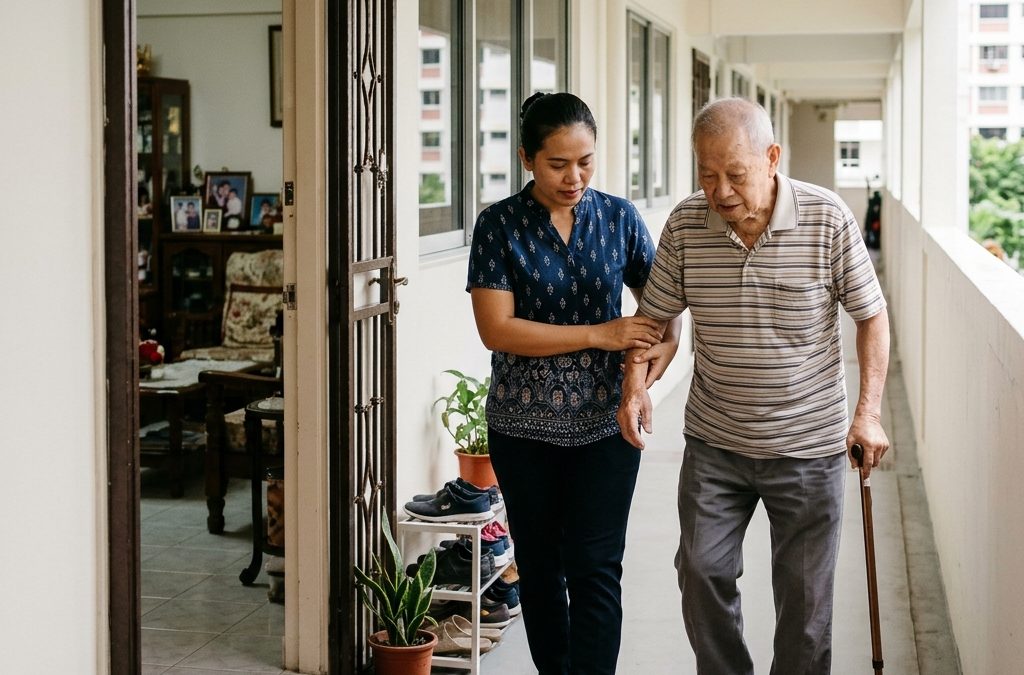
Living in a high-density Housing and Development Board (HDB) estate offers a sense of community, but for families caring for a loved one with cognitive decline, the open nature of these estates presents a significant safety risk. As dementia progresses, “exit-seeking behavior” or wandering becomes a primary concern for Singaporean households. When a family hires a domestic helper to assist with elderly care, the responsibility of preventing a loved one from wandering into a busy lift lobby or a crowded hawker centre falls heavily on her shoulders. At EELIT Agency Pte. Ltd., we recognize that managing dementia wandering in Singapore HDB flats requires more than just a watchful eye; it demands a structured set of safety protocols, environmental modifications, and a clear understanding of the evolving regulatory framework set by the Ministry of Manpower (MOM).
The Evolving Legal Framework: MOM 2026 and Caregiver Accountability
The Singapore government is moving toward a more structured ecosystem for elderly care, particularly as our population ages rapidly. Looking toward 2026, the Ministry of Manpower is expected to tighten the requirements for Foreign Domestic Workers (FDWs) who are specifically recruited for “high-needs” elderly care. This shift involves moving away from general domestic work toward a competency-based model. For employers, this means that hiring a helper for a dementia patient will soon require documentation of specialized training or the completion of mandatory caregiver modules under the Caregiver Training Grant (CTG) framework.
Under these upcoming regulations, the focus is on the “Duty of Care.” If a helper is found to be negligent while a vulnerable elderly person wanders and comes to harm, the employer may face scrutiny regarding the adequacy of the training provided and the safety of the living environment. EELIT Agency stays ahead of these changes by ensuring that our helpers are not just told to “watch the elderly,” but are taught to recognize the early signs of agitation that lead to wandering. Employers must understand that as the legal landscape evolves, the burden of proof regarding a helper’s competency will become more rigorous. Proper documentation of daily routines and safety briefings will become a standard requirement for every household employing a dementia wandering domestic helper in Singapore.
Understanding the Mechanics of Wandering in an HDB Context
Wandering is rarely aimless. In the context of an HDB flat, a person with dementia might be trying to “go to work,” “find their mother,” or “buy groceries” at a market that they frequented thirty years ago. The architecture of HDB blocks—with long common corridors, multiple lift lobbies, and interconnected stairwells—can be incredibly disorienting. Once a person steps out of the front gate, the repetitive nature of HDB floor designs makes it difficult for them to identify their own unit, leading to further panic and more rapid wandering.
The heat and humidity of Singapore also play a role. A person with dementia who wanders out at 2:00 PM is at immediate risk of heatstroke and dehydration. Unlike a house with a private garden, an HDB flat opens directly into public space. This means the transition from a safe zone to a high-risk zone happens in a matter of seconds. Therefore, the primary goal for any Singapore caregiver is to manage the environment so that the initial exit never occurs, while ensuring the person does not feel like a prisoner in their own home.
Hardening the Home: Physical Safety Protocols for HDB Flats
The first line of defense is the physical gate and door. Many Singaporean families rely on the standard metal gate and wooden door. However, a person with dementia can often operate a simple latch. 1. Consider installing a double-cylinder deadbolt that requires a key from the inside, but ensure all family members and the helper carry a key at all times to prevent entrapment during a fire. 2. A more modern solution is the installation of smart locks with geofencing alerts. These devices can send an immediate notification to the employer’s smartphone the moment the front door is opened.
Visual camouflage is another effective technique. For individuals with advanced dementia, a door is a “cue” to leave. By painting the door or the gate the same color as the surrounding walls, or by hanging a decorative curtain over the exit, the visual trigger to leave is removed. Additionally, placing a black mat in front of the gate can sometimes act as a “virtual hole” for a person with dementia; due to changes in depth perception, they may perceive the dark mat as a gap in the floor and hesitate to step on it. These small environmental tweaks, when combined with a vigilant domestic helper, significantly reduce the chances of an unmonitored exit.
The Helper’s Daily Surveillance Protocol: Beyond Constant Watching
Expecting a domestic helper to watch a patient 24 hours a day is neither realistic nor sustainable. Instead, EELIT Agency advocates for a protocol-driven approach. 1. The helper should maintain a “Sunsetting Log.” Wandering often occurs during the late afternoon (sundowning), when confusion increases. During these hours, the helper should engage the elderly person in structured activities like folding laundry or listening to familiar music to distract from the urge to leave. 2. The helper must be trained to use “re-direction” rather than “confrontation.” If a person says, “I need to go to the market,” the helper should not say “You cannot go.” Instead, she should say, “The market is closed now, let’s have some tea first and go later.”
Another critical daily protocol is the “ID Check.” The helper must ensure the elderly person is wearing a GPS tracker or a medical ID bracelet every single morning. In Singapore, several affordable options exist, such as the TraceTogether-style tokens modified for GPS or simple AirTags hidden in shoe soles or waistbands. The helper’s job is to ensure these devices are charged and properly attached as part of the morning dressing routine. This creates a safety net that remains active even if the physical barriers of the HDB flat fail.
High-Risk Transition Points in the Singapore Neighborhood
Wandering does not only happen from the home. It often occurs during outings to the nearby hawker centre, the polyclinic, or the neighborhood park. In these public spaces, the “Dementia Wandering Domestic Helper Singapore” strategy must shift to active accompaniment. 1. When walking, the helper should use the “Hand-Under-Hand” technique or maintain a firm but gentle grip on the elderly person’s arm, especially when crossing roads or navigating crowded bus interchanges. 2. If the elderly person needs to use a public toilet, the helper must never wait outside. She should accompany them into the cubicle area or use a disabled toilet to ensure they do not exit through a different door and disappear into the crowd.
Public transport is another major transition point. Many wandering incidents in Singapore involve the elderly boarding a bus or an MRT train and traveling several stops away. Helpers must be instructed to never let go of the elderly person’s hand while waiting at a bus stop. The arrival of a bus creates a moment of chaos where the elderly person might surge forward or the helper might be distracted by tapping her EZ-Link card. These seconds are when wandering incidents most frequently occur.
Emergency Response: What to Do When a Loved One Goes Missing
Despite the best protocols, a lapse can happen. When it does, every second counts. The family and the helper must have a pre-written Emergency Action Plan. 1. Immediately search the immediate floor, the stairwells, and the void deck. Persons with dementia often move downward, so checking the lower floors and the carpark is a priority. 2. Contact the nearest Neighborhood Police Post (NPP) or call 999. In Singapore, the police take “vulnerable person” reports very seriously and will initiate a search immediately. You do not need to wait 24 hours.
3. Use the power of the community. Post a clear, recent photo on the “Dementia Friends” app and local Facebook community groups for that specific HDB estate (e.g., “Tampines North Residents”). 4. The helper should stay at the void deck or the main entrance of the block in case the person returns, while another family member drives to the person’s former home or old workplace. Having a “Missing Person Kit” ready—which includes a current photo, a list of frequent locations they mention, and their NRIC number—is an essential part of the EELIT Agency safety standard for our employers.
The Psychological Toll and Burnout Prevention
Caring for a wanderer is an incredibly high-stress job for a domestic helper. The constant fear of the elderly person getting lost can lead to sleep deprivation and anxiety. If a helper is burnt out, her vigilance drops, and the risk of wandering increases. Employers should ensure their helper has adequate rest and clear “off-duty” time where another family member takes over the monitoring. At EELIT, we emphasize the importance of communication. Employers should have a weekly check-in with their helper to discuss any “near misses” or changes in the elderly person’s behavior.
Supporting the helper also means providing her with the right tools. If the elderly person is prone to waking up and wandering at 3:00 AM, the family should invest in bed sensors or floor pressure mats that sound an alarm in the helper’s room. This allows the helper to sleep more deeply, knowing she will be alerted if there is movement, rather than trying to sleep with one eye open. A well-rested caregiver is the most effective defense against wandering-related accidents.
How EELIT Agency Supports Singaporean Families
Finding the right domestic helper for a dementia patient is a specialized process. At EELIT Agency Pte. Ltd., we don’t just provide a list of candidates; we match families with individuals who have the temperament and, where possible, the prior experience in elderly care. We understand the nuances of the Singapore HDB environment and the specific stressors that come with it. Our role is to act as a bridge, ensuring that the helper understands the gravity of her responsibility and that the employer understands the support systems required to make the arrangement successful.
We provide guidance on the Caregiver Training Grant (CTG) and can recommend accredited training providers where your helper can learn hands-on skills for managing dementia. By focusing on the specific needs of “Dementia Wandering Domestic Helper Singapore” placements, we ensure that your loved one is not just supervised, but is cared for with dignity and safety. Our commitment is to the long-term stability of the caregiving arrangement, reducing the turnover rate of helpers and providing peace of mind to the working sandwich generation in Singapore.
Final Thoughts on Integrated Care
Managing dementia wandering in an HDB setting is a marathon, not a sprint. It requires a combination of physical security, smart technology, and a highly trained, compassionate domestic helper. By implementing the protocols outlined in this guide—ranging from HDB gate modifications to the “Sunsetting Log”—families can significantly mitigate the risks associated with cognitive decline. Remember that you are not alone in this journey. With the right support from EELIT Agency and a clear safety framework, it is possible to provide a secure and fulfilling life for your loved ones within the comfort of their own home.
Connect with EELIT Placement Specialists
Speak directly with our senior placement consultants for personalized bio matching, MOM Work Permit processing, and household caregiving support across Singapore:
Headquarters Priority WhatsApp (Direct Placement Team)
Juliet (HQ): +65 9100 1610 |
Joey (HQ): +65 9100 1610
Islandwide Branch WhatsApp Lines
Orchard (Far East Shopping Centre): +65 9478 2786
Hougang: +65 8043 9823
Yishun: +65 8090 3168