
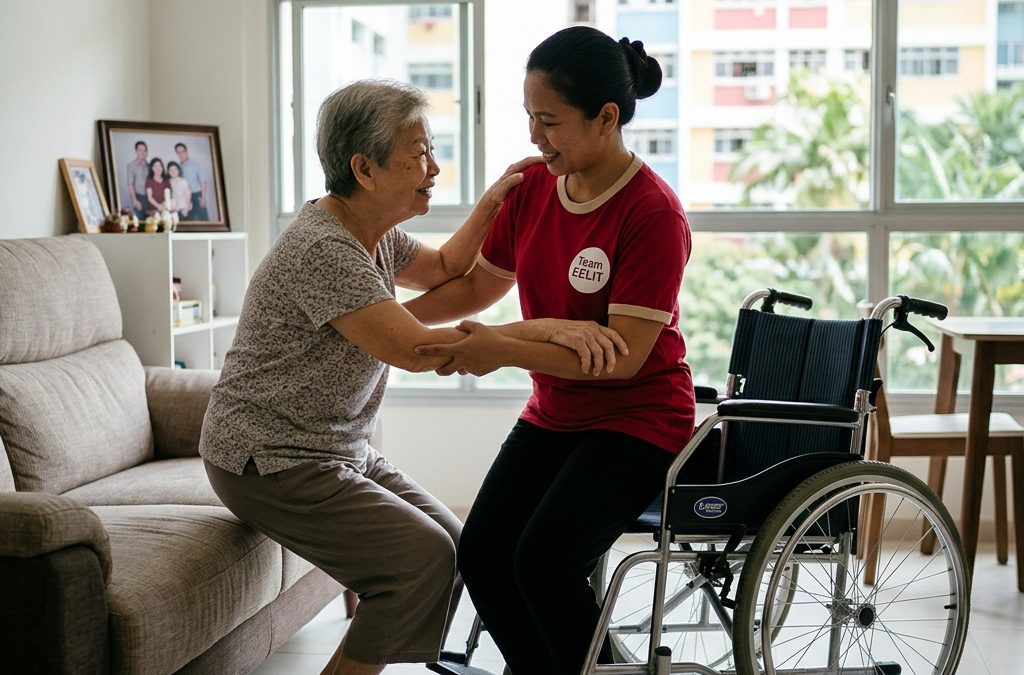
As Singapore navigates its transition into a super-aged society, the role of the Migrant Domestic Worker (MDW) has evolved from general housework to specialized eldercare. For many Singaporean families, bringing a helper into the home is the only way to manage the physical demands of an aging parent while maintaining a career. However, the physical toll on these caregivers is often overlooked until an injury occurs. Caregiver ergonomics is the science of designing the movement and environment to fit the worker, ensuring that your domestic helper can perform her duties without developing chronic back pain or musculoskeletal disorders. At EELIT Agency, we recognize that a helper who is physically strained cannot provide high-quality care. This guide provides an exhaustive look at safe transfer techniques and wheelchair handling specifically tailored for the Singaporean home environment.
The Evolving Regulatory Framework: MOM 2026 and Caregiver Safety
The Ministry of Manpower (MOM) and the Ministry of Health (MOH) have been progressively tightening the standards for eldercare training. Looking toward 2026, the Singapore government is placing a heavier emphasis on the “Age Well SG” initiative, which focuses on allowing seniors to age gracefully in their own HDB flats and private estates. This initiative brings with it a shift in expectations for MDWs. By 2026, we anticipate more rigorous competency frameworks for helpers who are declared as caregivers for elderly employers. This isn’t just about ensuring the senior is safe; it is about protecting the MDW from workplace injuries.
MOM guidelines currently encourage employers to enroll their helpers in the Caregivers Training Grant (CTG) eligible courses. These courses are becoming more comprehensive, moving beyond basic hygiene to include advanced biomechanics. Employers must understand that under the Work Injury Compensation Act (WICA), any injury sustained by a helper during the course of her caregiving duties—such as a slipped disc from an improper lift—is the employer’s responsibility. Therefore, investing in ergonomic training is both a moral obligation and a prudent financial decision to avoid medical costs and the loss of a valuable household member.
The Core Principles of Caregiver Ergonomics
Before a helper ever touches a wheelchair, she must understand the physics of her own body. Ergonomics in caregiving is based on the principle of minimizing the load on the spine by using the larger muscles of the legs. Many helpers come from backgrounds where manual labor is common, but they may have never been taught the specific techniques required to move a human being, who is “dead weight” that can shift unexpectedly.
- The Base of Support: The helper should always maintain a wide stance, with feet shoulder-width apart. This creates a stable foundation and prevents tipping when the senior’s weight shifts.
- The Center of Gravity: The helper must keep the person they are moving as close to their own body as possible. The further away the load is from the spine, the more force is exerted on the lower back.
- Using the Power Zone: All lifting and pulling should happen between the mid-thigh and mid-chest level. If a helper is reaching too high or bending too low, she is at high risk for a strain.
- Avoid the Twisting Motion: This is the most common cause of injury. A helper must never twist her torso while carrying a load. Instead, she must pivot her entire body by moving her feet.
Preparing the Environment for Safe Transfers
In the typical Singaporean HDB flat, space is often at a premium. Small bedrooms and narrow corridors make transfers difficult. To implement proper caregiver ergonomics, the environment must be optimized. First, ensure that the path between the bed and the wheelchair is clear of any loose rugs or clutter. Standard HDB flooring can be slippery, especially if there is residual moisture from cleaning, so the helper should always wear non-slip indoor footwear.
The height of the bed is another critical factor. If the bed is too low, the helper must bend excessively. If it is too high, the senior might slide off too quickly. Ideally, the bed should be at a height where the senior’s feet can touch the ground comfortably while they are sitting on the edge. If your home uses a hospital bed, the helper should be taught to adjust the height before every transfer to ensure she is working within her power zone.
Step-by-Step Guide to the Sit-to-Stand Transfer
The transition from a bed to a wheelchair is where most falls occur. A safe transfer requires clear communication and a synchronized movement between the helper and the senior. This protocol should be practiced until it becomes second nature for both parties.
First, the helper must explain what is about to happen. Even if the senior has dementia, hearing a calm voice explain “Ah Gong, we are going to move to the chair now” helps reduce sudden movements. The wheelchair should be placed at a 45-degree angle to the bed, on the senior’s stronger side. The brakes must be locked, and the footrests should be swung away to prevent tripping.
Second, the helper assists the senior to sit on the edge of the bed. The helper should stand in front of the senior, blocking the senior’s knees with her own to prevent their legs from buckling. Instead of pulling the senior up by their arms—which can cause shoulder dislocation—the helper should place her hands on the senior’s shoulder blades or use a specialized transfer belt (gait belt). On the count of three, using the momentum of a rock-and-roll motion, the senior stands while the helper shifts her weight from her front foot to her back foot.
Advanced Wheelchair Handling in the Singapore Landscape
Once the senior is in the wheelchair, the ergonomic challenges shift to the MDW’s wrists, shoulders, and neck. Handling a wheelchair in Singapore involves navigating ramps, lift thresholds, and the uneven pavements of older estates. To prevent strain, the helper should always push the wheelchair with her elbows slightly bent and her back straight. She should avoid leaning forward or “hunching” over the handles.
When approaching a curb or a high threshold in an HDB lift, the helper should use the tilt levers at the back of the wheelchair. By stepping on the lever and pulling back on the handles, the front casters lift, allowing the chair to roll over the obstacle. Never try to “heave” the chair up using only arm strength. When going down a steep ramp, such as those found at overhead bridge crossings or hospital entrances, the helper should turn the wheelchair around and go down backward. This prevents the senior from falling forward and gives the helper better control over the speed of the descent using her body weight as a brake.
The Role of Assistive Devices and Technology
At EELIT Agency, we often advise employers that manual lifting should be the last resort. As a senior’s mobility decreases, the physical demand on the helper increases exponentially. This is where assistive devices become essential components of caregiver ergonomics. A simple “Lazy Susan” style swivel disk can allow a senior to pivot from bed to chair with almost no lifting required from the helper.
Sliding sheets are another underutilized tool in Singaporean homes. Made of low-friction fabric, these sheets allow a helper to reposition a senior in bed or move them toward the edge without any lifting. For seniors who are completely non-ambulatory, a mechanical hoist or a stand-up lift is a necessary investment. While these devices require more space, they virtually eliminate the risk of back injury for the helper and provide a much safer experience for the senior. Employers should look into the Assistive Technology Fund (ATF) provided by the Agency for Integrated Care (AIC) to subsidize the cost of these tools.
Managing the Physical Health of the Helper
A helper who is tired is more likely to make a mistake in technique. Proper ergonomics includes the scheduling of rest. If a helper is required to perform twenty transfers a day, her muscles will fatigue, leading to a breakdown in form. Employers should encourage their helpers to perform daily stretching exercises focused on the lower back, hamstrings, and shoulders. These “micro-breaks” are essential for muscle recovery.
Hydration and nutrition also play a role. A helper needs adequate protein and calorie intake to maintain the muscle mass required for physical caregiving. If you notice your helper rubbing her back or moving stiffly, it is a sign that her ergonomic technique is failing or the workload is too high. Open communication is key; the helper should feel comfortable telling the employer if a particular transfer feels too heavy or if she needs additional help or equipment.
Common Mistakes to Avoid in Caregiver Ergonomics
Many untrained helpers rely on “arm strength” rather than “leg power.” They often grab the senior under the armpits, which is painful for the senior and puts an enormous strain on the helper’s biceps and upper back. Another common error is trying to catch a falling senior. If a senior begins to fall during a transfer, the ergonomic response is not to try and stop the fall, as this usually results in both people getting injured. Instead, the helper should guide the senior slowly to the floor by widening her stance and letting the senior slide down her leg.
Failure to lock wheelchair brakes is another frequent mistake that leads to avoidable accidents. In the rush to get things done, a helper might forget this simple step, causing the chair to roll away as the senior is sitting down. We teach our helpers at EELIT that “safety is speed.” Taking an extra ten seconds to check the brakes and the senior’s foot placement saves hours of medical emergencies and weeks of recovery from strain.
Psychological Aspects of Transferring and Handling
Ergonomics is not just about the body; it is also about the mind. A senior who is afraid of falling will be tense, making them harder to move. A helper who is stressed will have tense muscles, making her more prone to injury. Building a rapport of trust is an ergonomic strategy. When the senior trusts the helper’s movements, they become more relaxed and often more able to assist in the transfer by using whatever strength they have left. This “active participation” from the senior reduces the total weight the helper has to manage.
The helper should also be taught to manage the psychological pressure of being the sole caregiver. In multi-generational households, there can be conflicting instructions from different family members. This confusion can lead to hurried, unsafe movements. Establishing a standardized protocol that everyone in the family follows ensures the helper isn’t pressured into skipping safety steps.
How EELIT Agency Supports Your Family’s Caregiving Journey
Selecting a helper for eldercare is a different process than selecting one for general housekeeping. At EELIT Agency, we specialize in matching families with MDWs who have either prior nursing experience or a natural aptitude for physical caregiving. Our screening process includes assessing the helper’s physical capability and her willingness to undergo specialized ergonomic training.
We do not just stop at the placement. We guide employers on the available Singaporean grants and training programs, such as those offered by the Foreign Domestic Worker Association for Social Support and Training (FAST) or the AIC. We believe that a well-trained helper is a long-term asset to the family. By prioritizing caregiver ergonomics from day one, you ensure that your helper stays healthy, your elderly parents stay safe, and your household remains a place of care rather than a source of stress.
Our commitment at EELIT is to provide more than just a labor solution; we provide a care solution. This involves ongoing support for the employer to ensure that the home environment is optimized for safety. Whether it is advising on the right type of wheelchair or helping you understand the latest MOM regulations, we are your partners in navigating the complexities of Singaporean home care. Protecting the physical health of your helper through proper ergonomics is the best way to ensure the longevity and quality of the care she provides to your loved ones.
Connect with EELIT Placement Specialists
Speak directly with our senior placement consultants for personalized bio matching, MOM Work Permit processing, and household caregiving support across Singapore:
Corporate Headquarters Placement Consultation
Corporate HQ Priority WhatsApp: +65 9100 1610
Juliet (Senior Consultant): Chat with Juliet (+65 9168 2493) |
Joey (Senior Consultant): Chat with Joey (+65 8725 2891)
HQ Office Telephone (Hotline / Voice Call Only): +65 6320 3826
Islandwide Branch WhatsApp Lines
Orchard (Far East Shopping Centre): +65 9478 2786
Hougang: +65 8043 9823
Yishun: +65 8090 3168