
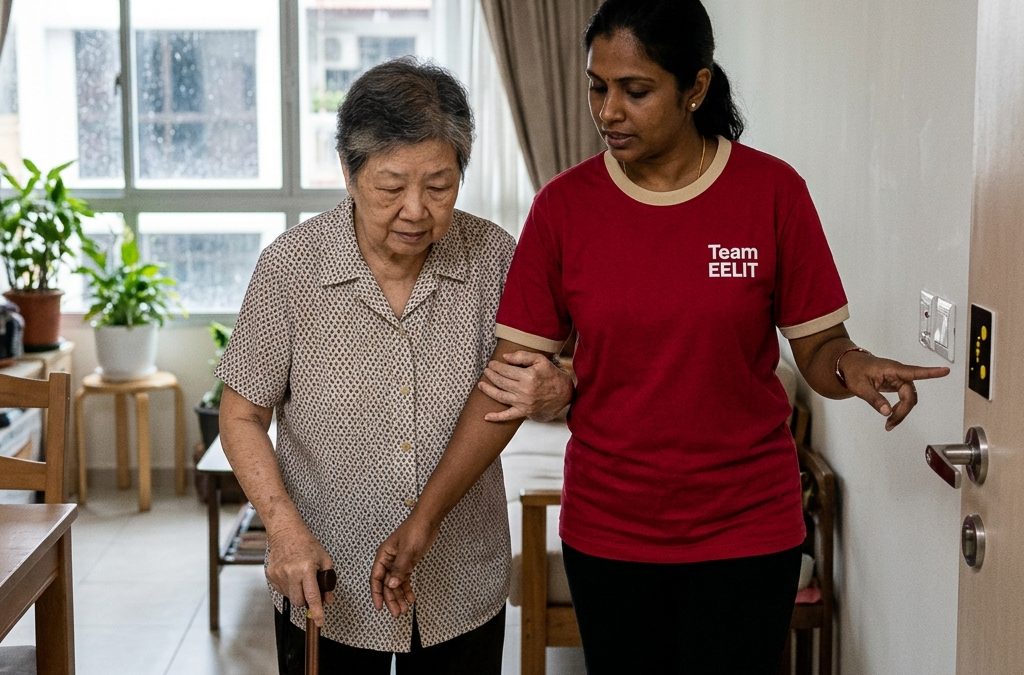
Managing a household where a senior family member experiences significant vision loss requires a shift in perspective that goes beyond simple home modifications. In Singapore, where multi-generational living is common and the reliance on Migrant Domestic Workers (MDWs) is high, the responsibility of ensuring safety and dignity for visually impaired elders often falls on the shoulders of these domestic helpers. This guide provides a comprehensive framework for Singaporean families to train their helpers in vision loss support, ensuring that your home remains a sanctuary rather than a maze of hazards. At EELIT Agency, we recognize that caregiving for the visually impaired is a specialized skill set that requires patience, precise communication, and a rigorous adherence to safety protocols.
The Regulatory Landscape: MOM 2026 and Caregiver Accountability
As we approach 2026, the Ministry of Manpower (MOM) in Singapore is placing an even greater emphasis on the specialized training of domestic helpers assigned to eldercare. The upcoming regulatory shifts focus on ensuring that MDWs are not just general cleaners but are competent caregivers who understand the specific medical and physical needs of their charges. For families hiring a helper for a senior with vision impairment, this means a greater expectation for documented training and competency checks. Employers are encouraged to utilize the Caregivers Training Grant (CTG) to upskill their helpers. At EELIT Agency, we align our placement process with these evolving standards, ensuring that the helper you hire is prepared for the mental and physical demands of vision loss support.
The 2026 framework also highlights the importance of the MDW’s well-being and clear job scopes. When a senior has low vision, the helper’s task list shifts from heavy housework to constant supervision and environmental management. Families must recognize that a helper managing a senior with vision loss cannot be expected to maintain a large bungalow’s cleanliness while simultaneously providing one-on-one navigation support. Clear communication regarding these priorities is essential to remain compliant with MOM’s guidelines on fair workload and the safety of the vulnerable person under their care.
Understanding the Senior’s Visual World
Vision loss in seniors often manifests as more than just blurriness. It can include the loss of peripheral vision (tunnel vision), the loss of central vision (macular degeneration), or a general clouding of sight (cataracts). For a domestic helper to provide effective vision loss support, she must first understand how her employer sees the world. We recommend that employers conduct a simple empathy exercise with their helpers, such as using smeared glasses or cardboard tubes to simulate different types of vision loss. This helps the helper realize why a senior might miss a glass of water sitting right in front of them or why they might trip over a footstool that seems obvious to everyone else.
Once the helper understands the specific nature of the senior’s impairment, she can adjust her caregiving style. For example, if the senior has lost their peripheral vision, the helper must learn to always approach them from the front and announce her presence before getting close. This prevents the senior from being startled, which is a common cause of falls and anxiety in low-vision households. Understanding the medical diagnosis also helps the helper report changes in the senior’s condition more accurately to the family or the doctor.
Establishing High-Contrast Home Navigation
The Singaporean HDB or condominium often features neutral tones, white walls, and tiled floors. While aesthetically pleasing, this lack of contrast is a significant hazard for someone with vision loss. To support the senior’s independence, the domestic helper should be tasked with maintaining a high-contrast environment. This means placing dark mats on light-colored floors at transition points, such as the entrance to the bathroom or the kitchen. If the senior uses a white plate, the helper should place it on a dark-colored placemat so the edges of the dish are clearly visible.
Step edges are particularly dangerous in Singaporean homes with raised floorings or small steps into the toilet. The helper should ensure that these edges are marked with bright, non-slip adhesive tape, typically in yellow or orange. Furthermore, lighting plays a critical role. Shadows can be interpreted as holes or obstacles by a visually impaired senior. The helper should be instructed to keep all areas well-lit, ensuring that bulbs are replaced immediately upon flickering and that curtains are opened during the day to provide maximum natural light without creating harsh glares on polished floor surfaces.
The Sighted Guide Technique: Safe Mobility Protocols
Walking with a visually impaired senior is not about pulling them along or pushing them from behind. The domestic helper must be trained in the Sighted Guide Technique. In this protocol, the senior holds the helper’s arm just above the elbow. This allows the senior to feel the helper’s body movements and anticipate turns or changes in elevation. The helper should walk half a step ahead, maintaining a consistent pace that is comfortable for the senior. This technique fosters a sense of security and gives the senior control over their own movement.
During navigation, the helper must provide verbal cues that are specific and descriptive. Instead of saying “Go over there,” she must say, “We are walking forward three steps, then turning left toward the dining chair.” When approaching a flight of stairs, the helper must stop, inform the senior whether they are going up or down, and ensure the senior’s hand is securely on the railing before proceeding. Consistent practice of this technique prevents the “dragging” motion that often leads to shoulder injuries or loss of balance for the elderly.
Dining and Mealtime Support: The Clock Method
Mealtime can be a source of frustration and loss of dignity for seniors with vision impairment. To provide effective vision loss support, the helper should implement the Clock Method for every meal. This involves describing the location of food on the plate as if it were the face of a clock. For instance, the helper might say, “Your rice is at six o’clock, the steamed fish is at ten o’clock, and the vegetables are at two o’clock.” This simple protocol allows the senior to feed themselves with minimal assistance, preserving their autonomy.
Beyond the plate, the helper must ensure that the dining environment is predictable. The water glass should always be placed in the same spot, and the helper should guide the senior’s hand to the glass to confirm its location before they start eating. Hot liquids should never be filled to the brim, and the helper should describe the temperature of the food to prevent burns. By standardizing the mealtime routine, the family reduces the senior’s anxiety around eating and ensures they receive proper nutrition without the stress of “searching” for their food.
Managing Clutter and Environmental Consistency
The number one rule for a domestic helper in a low-vision household is: never move the furniture without permission. For a visually impaired senior, their home is mapped out in their mind based on the position of the sofa, the coffee table, and the cabinets. Moving a chair by even a few inches can lead to a collision. The helper must be trained to keep the floors absolutely clear of clutter, including shoes, charging cables, and floor rugs which are notorious tripping hazards in Singaporean homes.
Doors and cabinets also present a hidden danger. A half-open door is difficult to see and can cause head or facial injuries. The protocol for the helper should be “all or nothing”—doors must be either fully closed or pushed completely open against the wall. Similarly, kitchen cabinet doors must be shut immediately after use. The helper’s role involves constant environmental scanning to ensure that the senior’s paths are always unobstructed, particularly the route from the bedroom to the bathroom, which is the most common path for nighttime falls.
Communication Protocols and Social Interaction
Vision loss often leads to social withdrawal because the senior cannot see facial expressions or recognize people entering the room. The domestic helper must be the senior’s eyes and ears. Every time the helper enters the room, she should announce herself by name: “Madam, it is Maria, I am coming in to bring your laundry.” Before she leaves, she must state that she is departing so the senior isn’t left talking to an empty room, which can be disorienting and embarrassing.
Furthermore, the helper should be encouraged to read the newspaper, letters, or even describe scenes from a television show to the senior. This keeps the senior mentally engaged and connected to the world. When guests arrive, the helper should quietly identify who is in the room and where they are seated. This level of support goes beyond physical safety; it addresses the emotional and psychological well-being of the elderly family member, preventing the isolation that so often accompanies blindness.
Emergency Protocols for Visually Impaired Households
In the event of an emergency, such as a fire or a medical crisis, a visually impaired senior is at extreme risk. The domestic helper must be the primary coordinator for evacuation. We recommend that families work with their helpers to establish a clear exit route that is practiced regularly. The helper should know exactly where the senior’s emergency bag, medications, and identification documents are kept. In a high-rise Singaporean context, the helper must understand that elevators are not to be used during a fire and must be physically prepared to assist the senior down the stairs using the Sighted Guide Technique under stress.
Medical emergencies, such as a sudden fall, require the helper to stay calm. She must be trained on how to assess for injuries without moving the senior unnecessarily. Every helper placed by EELIT Agency for eldercare is briefed on the importance of having emergency contact numbers on speed dial and knowing how to communicate the senior’s location and condition to the SCDF (Singapore Civil Defence Force). A clear, written emergency plan should be posted on the refrigerator, accessible for the helper to reference in a moment of panic.
The Role of EELIT Agency in Your Caregiving Journey
At EELIT Agency, we understand that finding the right domestic helper for a senior with vision impairment is a delicate process. It requires more than just a match of skills; it requires a match of temperament. We vet our candidates for their patience, their ability to follow complex instructions, and their communication skills. We provide employers with the resources needed to bridge the gap between a new helper’s arrival and the establishment of a safe, functioning household.
Our commitment to Singaporean families involves ongoing support. We assist in identifying the specific training needs of your MDW and can point you toward certified courses that qualify for the CTG. By choosing a specialized agency, you are not just hiring a worker; you are securing a partner in your family’s caregiving team. We ensure that our helpers understand the gravity of their role in vision loss support and the legal and ethical standards required by the MOM and the Singaporean community.
Ultimately, the goal is to create a home environment where your elderly loved ones feel safe, respected, and capable. With the right protocols, a dedicated domestic helper, and the professional guidance of EELIT Agency, vision loss does not have to mean a loss of quality of life. It simply means adapting the way we navigate the world, one step at a time, with confidence and care.
Connect with EELIT Placement Specialists
Speak directly with our senior placement consultants for personalized bio matching, MOM Work Permit processing, and household caregiving support across Singapore:
Corporate Headquarters Placement Consultation
Corporate HQ Priority WhatsApp: +65 9100 1610
Juliet (Senior Consultant): Chat with Juliet (+65 9168 2493) |
Joey (Senior Consultant): Chat with Joey (+65 8725 2891)
HQ Office Telephone (Hotline / Voice Call Only): +65 6320 3826
Islandwide Branch WhatsApp Lines
Orchard (Far East Shopping Centre): +65 9478 2786
Hougang: +65 8043 9823
Yishun: +65 8090 3168