
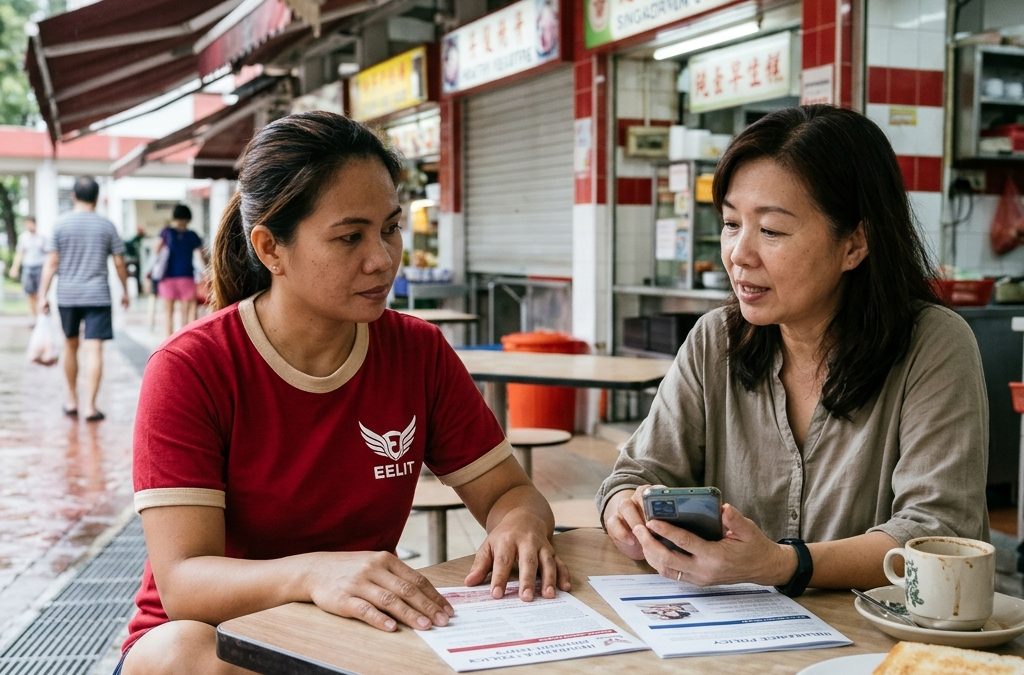
Sunday evening is usually a time for Singaporean families to unwind and prepare for the work week ahead. However, that peace can be shattered by a single phone call or a frantic message from your domestic helper. She might be at the hospital after a fall during a hiking trip or an accident at a shopping mall. In that moment, your mind likely floods with questions. Who pays for the medical bill since it happened on her day off? Is this covered under the Work Injury Compensation Act? Do I still need to pay her salary while she recovers? At EELIT Agency, we understand that these situations are fraught with both financial concern and genuine worry for your helper’s well-being. Navigating the intersection of Ministry of Manpower (MOM) regulations, insurance policies, and household management requires a clear head and a solid understanding of your obligations as an employer in 2026.
The Legal Framework: Work-Related vs. Personal Injury
The first distinction every Singaporean employer must understand is the difference between a work-related injury and a personal one. Under the current 2026 MOM guidelines, the Work Injury Compensation Act (WICA) generally covers injuries that arise out of and in the course of employment. If your helper slips while mopping your kitchen or burns her hand while preparing your family’s dinner, it is a clear-cut WICA case. However, when an injury occurs on a rest day while she is out personal errands or meeting friends, it falls outside the scope of WICA. This does not mean you have zero responsibility, but the mechanisms for payment and compensation change significantly.
For injuries sustained during her free time, your primary protection and hers comes from the mandatory Personal Accident Insurance (PAI) and Medical Insurance (MI) that you are required to maintain as part of her work permit conditions. In recent years, MOM has increased the minimum coverage for these policies to ensure that employers are not hit with catastrophic bills for non-work-related incidents. Even though the accident happened while she was off duty, you remain legally responsible for her medical costs and maintenance as her sponsor in Singapore, provided the costs fall within the reasonable limits of insurance or your contractual obligations.
Immediate Emergency Protocols for Employers
When you receive news of an off-duty injury, your first priority is ensuring she receives appropriate medical attention. If she is already at a hospital, find out which one and the severity of her condition. In Singapore, it is highly advisable to ensure she is treated at a restructured hospital (public hospital) in a subsidized ward, such as Class B2 or C. The medical insurance policies mandated by MOM are designed to cover these levels of care. If she is admitted to a private hospital or a higher ward class, you may find yourself paying significant out-of-pocket expenses that exceed your insurance limits.
Once she is stable, you must begin the documentation process. Collect the original medical bills, the inpatient discharge summary, and any medical certificates (MC) issued by the doctor. These documents are vital for insurance claims. You should notify your employment agency, like EELIT Agency, as soon as possible. We help you navigate the communication with the insurer and ensure that the notification happens within the required timeframe, usually within 30 days of the incident. Failing to notify the insurer promptly can lead to complications or even rejection of the claim.
Understanding Your Financial Liability
There is a common misconception that if a helper is injured while “playing” or “relaxing” on a Sunday, the employer is completely off the hook for the bills. This is not the case. Under the Employment of Foreign Manpower Act, you are responsible for the cost of her medical treatment in Singapore. The Personal Accident Insurance (PAI) is specifically designed to provide a lump-sum payout in the event of permanent disability or death resulting from an accident, regardless of whether it happened during work hours. As of the 2026 regulations, the minimum PAI sum insured remains at $60,000, providing a safety net for the helper’s family if she can no longer work.
For the hospital bills themselves, your mandatory Medical Insurance (MI) comes into play. Most standard policies now provide at least $60,000 of coverage per year for hospitalization and day surgery. If the surgery and hospital stay for her rest-day injury cost $15,000, your insurance should cover this, subject to the co-payment rules introduced in recent years. In current practice, many policies involve a co-payment where the employer pays a small percentage of the bill (often the first $500 or a 25% share above a certain amount) and the insurer covers the rest. It is essential to review your specific policy to understand your exact “out-of-pocket” exposure.
Medical Leave and Salary Obligations
If the injury requires her to stay home and rest, she will be issued a Medical Certificate. In Singapore, Migrant Domestic Workers (MDWs) are entitled to paid sick leave and paid hospitalization leave if they have served for at least three months. Specifically, they are entitled to up to 14 days of paid outpatient sick leave and up to 60 days of paid hospitalization leave per year. The 60 days of hospitalization leave includes the 14 days of outpatient sick leave.
If her rest-day injury results in a doctor prescribing 20 days of bed rest, you must continue to pay her full monthly salary for those 20 days, as long as she hasn’t exhausted her 60-day annual entitlement. You cannot deduct her salary for the days she was unable to work due to a legitimate injury, even if it happened while she was out with her friends. Furthermore, you are responsible for her upkeep, which includes providing her with adequate food and a safe place to recover, just as you would if she were working normally.
Managing the Recovery Period at Home
A helper in recovery can change the dynamic of a busy Singaporean household. If she is immobile or has restricted movement, she cannot perform her usual duties such as childcare, elderly care, or heavy cleaning. This is often the point where employers feel the most stress. You are paying her salary and medical bills while also having to do the chores yourself or hire part-time help. It is important to approach this with patience. Forcing a helper to work before she is medically cleared can lead to a relapse or a more serious injury, which would then be classified as a work-related incident under your roof.
During her recovery, clear communication is necessary. If she is able to do light tasks, such as folding laundry while sitting down, you can discuss this with her. However, you must respect the doctor’s orders. If the MC says “strict bed rest,” then she must rest. Many families find it helpful to hire a temporary part-time cleaner during this period to bridge the gap. We often remind our clients that the way you treat your helper during her time of injury significantly impacts her loyalty and morale once she is back on her feet.
When the Injury is Permanent or Long-Term
In some unfortunate cases, a rest-day injury may be so severe that the helper can no longer perform her domestic duties. Examples include severe spinal injuries from a fall or permanent loss of limb function. If the medical assessment concludes that she is no longer fit for domestic work in Singapore, you will need to look into the process of medical repatriation. This is a sensitive situation that requires careful handling to ensure her dignity and rights are respected.
Before any decision is made to cancel her work permit, you must ensure she is medically fit to travel. The doctor must certify that she can board a plane or that special medical transport is arranged. The cost of the airfare back to her home country is the employer’s responsibility. However, if the injury was an accident covered by the Personal Accident Insurance, she may be entitled to a lump-sum payout for permanent disability. This payout is meant to provide for her future since her earning capacity has been compromised. EELIT Agency assists in these difficult transitions, ensuring that all MOM requirements are met and that the helper receives all the insurance benefits she is entitled to before she departs.
Practical Steps to Minimize Risk
While you cannot control what happens when your helper is out of the house, you can take proactive steps to minimize risks. We recommend having an open conversation with your helper about safety during her rest days. This is not about restricting her freedom, but about mutual protection. You might suggest she avoid high-risk activities if she is not physically prepared for them, or remind her to stay hydrated and take care in crowded areas. Encouraging her to have a “buddy system” where she always goes out with at least one friend who has her contact information is also a practical safety measure.
1. Keep a digital folder of her insurance policy details and the emergency contact numbers for the insurer.
2. Ensure she has your contact information and the agency’s contact details saved in her phone and written in her wallet.
3. Periodically review your insurance coverage. Some basic policies have low limits that might not be sufficient for a major surgery in 2026. Upgrading to a plan with higher medical limits (e.g., $80,000 or $100,000) often costs only a small amount more in annual premiums but provides significantly better protection for your family’s finances.
4. Maintain a good relationship with your helper so she feels comfortable telling you immediately if she has a minor injury, preventing it from becoming a major infected wound or a chronic issue later on.
Common Scenarios and How to Handle Them
Consider a scenario where your helper is hit by a cyclist while walking in a park on Sunday. If the cyclist is at fault, there may be a third-party liability claim. However, hospital bills must be paid upfront. You should use her medical insurance to settle the bills first. If there is a successful claim against the cyclist later, the insurer may seek subrogation. You should not wait for a legal settlement to provide her with medical care; as her employer, you are the primary guarantor of her health services while she is in Singapore.
Another common scenario involves “hidden” injuries. A helper might fall on Sunday, feel fine, and then wake up on Tuesday with a swollen ankle. Because the injury manifested during a work day, there might be a temptation to claim it as a work injury to get 100% coverage under WICA. We strongly advise against this. MOM takes a very serious view of false work-injury claims. If the injury happened on a Sunday, it should be reported as such. Honesty in documentation ensures that your insurance claims are processed smoothly without the risk of legal penalties for making a false declaration.
How EELIT Agency Supports Your Family
Dealing with an injured helper is a stressful period for any household. At EELIT Agency, our role extends far beyond the initial placement of a helper. We act as your primary resource and mediator during these crises. Our specialists are well-versed in the latest 2026 MOM regulations and can provide immediate clarity on whether a situation falls under WICA or standard medical insurance. We help you communicate with the helper and her family back home, ensuring that everyone is informed and reassured about the care she is receiving.
We also assist with the administrative burden. From explaining the nuances of insurance co-payments to helping you file the necessary claims and documentation with the insurers, our goal is to let you focus on your family while we handle the red tape. If the injury results in a long-term inability to work, we guide you through the process of finding a replacement helper while ensuring the departing helper’s medical and repatriation needs are managed ethically and legally. Our deep experience in the Singapore employment landscape means we have seen these scenarios many times and can provide the calm, authoritative advice you need to make the right decisions.
Managing a domestic helper involves more than just delegating chores; it is a commitment to the well-being of another person within your home ecosystem. While an injury on a rest day is an unplanned disruption, being prepared with the right insurance and a clear understanding of the law ensures that it remains a manageable hurdle rather than a financial or legal disaster. By staying informed and working closely with a trusted agency like EELIT, you protect your helper, your family’s finances, and the harmony of your household.
Connect with EELIT Placement Specialists
Speak directly with our senior placement consultants for personalized bio matching, MOM Work Permit processing, and household caregiving support across Singapore:
Corporate Headquarters Placement Consultation
Corporate HQ Priority WhatsApp: +65 9100 1610
Juliet (Senior Consultant): Chat with Juliet (+65 9168 2493) |
Joey (Senior Consultant): Chat with Joey (+65 8725 2891)
HQ Office Telephone (Hotline / Voice Call Only): +65 6320 3826
Islandwide Branch WhatsApp Lines
Orchard (Far East Shopping Centre): +65 9478 2786
Yishun: +65 8090 3168