
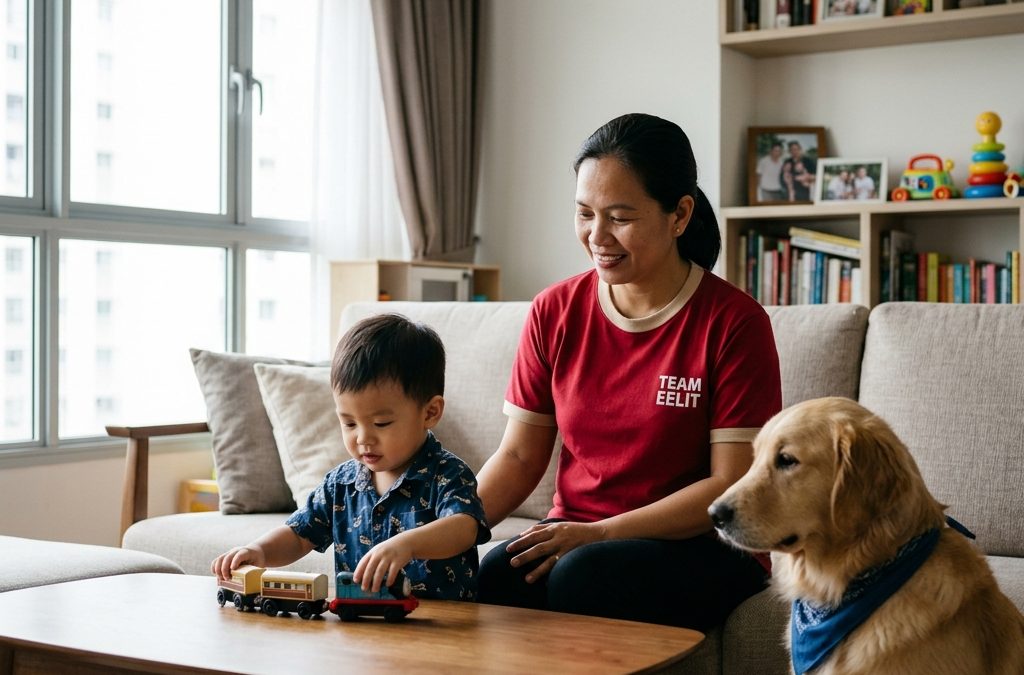
Managing a household that includes both a spirited toddler and a beloved family pet is a balancing act that requires precision, patience, and clear communication. For many Singaporean families, the Migrant Domestic Worker (MDW) serves as the glue that holds these moving parts together. However, expecting a helper to instinctively navigate the complexities of pet behavior and child safety without a structured framework is a recipe for burnout or, worse, an avoidable accident. At EELIT Agency Pte. Ltd., we recognize that your home is a unique ecosystem where the safety of your child and the welfare of your pet must coexist with the well-being of your helper. This guide provides an exhaustive blueprint for coordinating your domestic helper to manage both toddlers and pets safely, ensuring a harmonious environment for everyone under your roof.
The Evolving Legal Framework: MOM 2026 and MDW Welfare
As we approach 2026, the Ministry of Manpower (MOM) has significantly tightened the regulations surrounding the employment of Migrant Domestic Workers in Singapore. The core of these updates focuses on the mental well-being and workload management of the helper. When a family requires an MDW to care for both a toddler and a pet, the workload is classified as “high intensity.” Employers must be transparent in the employment contract about these dual responsibilities. Failing to disclose the presence of pets or the age of the children during the hiring process can lead to contract disputes and potential intervention by MOM.
The 2026 standards emphasize that a helper must have sufficient rest to maintain the alertness required for child safety. If a helper is tasked with waking up at 5:00 AM to walk a dog and is still managing a toddler’s bedtime at 9:00 PM, the risk of fatigue-related errors increases. At EELIT, we advise employers to document a clear rest schedule. This is not just a suggestion; it is a strategic move to ensure your helper remains sharp enough to intervene if a toddler crawls too close to a dog’s food bowl or if a cat gets agitated. A tired helper is a distracted helper, and in a house with pets and small children, distraction is a luxury you cannot afford.
Defining the Primary Role: Nanny vs. Pet Handler
One of the most common mistakes Singaporean employers make is failing to prioritize the helper’s tasks. You must clearly communicate whether the helper is primarily a child caregiver who helps with the pet, or a general housekeeper who assists with the child. In a household with a toddler and a pet, the toddler’s safety must always take precedence. This means that if the dog needs a walk while the toddler is awake and active, the helper should not be expected to do both simultaneously unless the child is securely strapped into a stroller.
1. Establish a hierarchy of tasks. For example, if the toddler is crying, the pet’s grooming or feeding can wait ten minutes.
2. Define the “Red Zones.” These are times of the day when the helper must focus exclusively on the child, such as meal times or bath times. During these windows, the pet should be kept in a separate room or a crate to prevent any accidental interference or hygiene issues.
3. Clarify the pet handling expectations. Is the helper expected to wash the dog, or just provide food and water? Does the helper need to administer medication to the pet? Each additional task adds a layer of responsibility that requires specific training and time allocation.
Establishing Physical Boundaries and “Safe Zones”
The physical layout of a Singaporean apartment, whether it is a built-to-order HDB or a private condominium, often places toddlers and pets in close proximity. To coordinate your helper effectively, you must implement physical boundaries that she can easily manage. This reduces the cognitive load on the helper, as she won’t have to constantly “police” the interactions between the child and the animal.
We recommend installing sturdy baby gates that can separate the kitchen or the pet’s sleeping area from the main living space. Your helper should be instructed to keep these gates closed at all times. The toddler should have a “pet-free zone” where they can play with small toys that might otherwise be a choking hazard for a dog or an invitation for a cat to pounce. Conversely, the pet needs a “toddler-free zone”—a crate or a specific corner—where they can retreat when they feel overwhelmed. Your helper must be the enforcer of these boundaries, ensuring the toddler does not disturb the pet while it is eating or sleeping.
The Hygiene Protocol: Managing Health Risks
In a tropical climate like Singapore, hygiene is a significant concern when pets and toddlers share a space. Toddlers are prone to putting their hands in their mouths, and pets naturally carry bacteria, fur, and occasionally parasites. Your helper needs a strict daily hygiene checklist to mitigate these risks. This protocol should be practiced until it becomes second nature.
1. Handwashing Rigor: The helper must wash her hands after handling the pet and before touching the toddler’s food, bottles, or toys. More importantly, she must supervise the toddler’s handwashing after any interaction with the pet.
2. Surface Sanitization: Floors should be vacuumed or mopped at least once a day to remove pet hair and dander. If the pet has an accident indoors, the helper must use an enzymatic cleaner and ensure the toddler is kept away from the area until it is completely dry and sanitized.
3. Toy Separation: It is vital to keep “dog toys” and “human toys” separate. Your helper should be trained to immediately remove any pet toys that find their way into the toddler’s play area, as these are often covered in saliva and bacteria.
Training Your Helper to Read Animal Body Language
Many domestic helpers come from backgrounds where pets are kept outdoors or are not treated as indoor family members. They may not be familiar with the subtle signs of stress in a dog or a cat. At EELIT, we emphasize that part of an employer’s responsibility is to educate the helper on the specific personality and warning signs of their pet. A dog does not usually bite without warning; it stiffens its body, whites its eyes, or tucks its tail first.
Spend the first two weeks of employment observing your helper’s interaction with the pet. Teach her to recognize the “whale eye” (when the white of the dog’s eye is visible) or a low growl. Instruct her that if the pet shows any sign of discomfort, she must immediately but calmly remove the toddler from the situation. She should never punish the pet for growling, as this can suppress the warning sign and lead to a bite without notice. Instead, her role is to be a proactive monitor of the environment, intervening before the pet feels the need to defend itself from a toddler’s uncoordinated hug or tail-pull.
The Daily Routine: A Sample Coordination Schedule
Structure is the enemy of chaos. A well-coordinated day allows the helper to transition between childcare and pet care without feeling overwhelmed. Below is an example of how a Singaporean household might structure a helper’s day to balance these duties effectively.
Morning (6:30 AM – 9:00 AM): The helper focuses on the pet’s morning walk and feeding while the parents handle the toddler’s initial wake-up routine. Once the helper returns, she transitions to assisting with the toddler’s breakfast while the pet rests in its designated zone.
Mid-Morning (9:00 AM – 12:00 PM): While the toddler is engaged in supervised play or attending a playgroup, the helper performs light housekeeping and manages pet-related chores, such as cleaning the litter box or washing pet bowls. If the toddler naps, this is the helper’s window for her own break and deeper cleaning.
Afternoon (12:00 PM – 5:00 PM): This is often the highest-risk period. The helper must manage lunch and afternoon activities. If the pet is active, it should be kept in a separate area during the toddler’s mealtime to prevent “begging” or accidental knocks. The helper focuses on the child’s learning and stimulation.
Evening (5:00 PM – 8:00 PM): As the family reunites, the helper may assist with the pet’s second walk or evening meal. Again, the toddler should be under the direct supervision of a parent or securely occupied during the pet’s transition times.
Addressing Cultural Differences and Fear of Animals
It is a reality that some MDWs may have an inherent fear of certain animals, particularly large dogs, due to their upbringing or past experiences. When hiring through EELIT, we conduct thorough screenings to match families with helpers who are genuinely comfortable with animals. However, even an animal-loving helper needs time to bond with your specific pet. Coordination starts with a positive relationship between the MDW and the animal.
Encourage your helper to be the one who provides high-value treats or meals to the pet in the beginning. This helps the pet associate the new person with positive outcomes. If the helper is nervous, the pet will pick up on that energy, which can lead to anxiety in the animal. As an employer, you must remain patient. Do not force the helper to handle the pet if she is visibly shaken; instead, work on building her confidence through gradual exposure and clear safety instructions.
Emergency Preparedness: When Things Go Wrong
Even with the best coordination, accidents can happen. Your helper must be empowered and trained to handle emergencies involving both the toddler and the pet. This includes having a clear list of emergency contacts, including the nearest pediatrician, the 24-hour emergency vet, and your own contact numbers. This list should be printed and displayed prominently on the refrigerator or a common area.
The helper should know the basic first-aid steps for a minor scratch or nip. For the toddler, this involves washing the area with soap and water and notifying the parents immediately. For the pet, it might involve checking for injuries if the toddler accidentally dropped something on them. More importantly, the helper must know that she will not be unfairly blamed for an accident if she followed the established protocols. Creating a culture of honesty ensures that she will report “near-misses,” allowing you to adjust your home’s coordination before a real injury occurs.
The EELIT Support System: Finding the Right Match
Coordination is significantly easier when you start with the right candidate. At EELIT Agency Pte. Ltd., our role as a licensed Singapore Employment Agency goes beyond just paperwork. We specialize in “compatibility matching.” When a family presents us with the challenge of managing a toddler and a pet, we look for specific traits in our MDW candidates: high situational awareness, a calm demeanor, and previous experience in multi-care households.
1. Rigorous Interviewing: We ask situational questions, such as “What would you do if the dog started barking while you were changing the baby’s diaper?” This reveals the candidate’s ability to prioritize and stay calm.
2. Documentation and Orientation: We help employers draft comprehensive job scopes that clearly outline the dual responsibilities, ensuring that there are no surprises for the helper upon arrival.
3. Post-Placement Support: If friction arises between the helper and the pet, or if the workload needs re-adjusting, our consultants are available to provide mediation and advice to ensure the placement remains stable.
Integrating Technology for Better Supervision
In modern Singaporean homes, technology can be a powerful ally for a domestic helper. We often recommend that employers install smart cameras in common areas. This is not about “spying” on the helper, but rather about providing an extra layer of safety and a way to review incidents. If the helper reports that the dog is acting strangely around the toddler, you can review the footage to see the trigger. This objective data allows you to refine your coordination strategies and provide better instructions to your helper.
Furthermore, automated pet feeders and self-cleaning litter boxes can reduce the manual labor required of your helper. By automating the routine aspects of pet care, you free up her time and mental energy to focus on the more critical task of toddler supervision. Every minute saved on a mundane chore is a minute she can spend being vigilant about your child’s safety.
Conclusion: A Harmonious Home is a Coordinated One
The secret to successfully managing pets and toddlers under one roof lies in the recognition that your domestic helper is a professional who needs a clear roadmap. By following the 2026 MOM guidelines, establishing firm physical and hygienic boundaries, and providing specific training on animal behavior, you transform a potentially chaotic household into a structured, safe, and happy environment. Your helper should not be expected to be a mind-reader; she should be an empowered member of your household team who knows exactly what to do in every scenario.
At EELIT Agency Pte. Ltd., we are committed to helping Singaporean families navigate these complexities. From the initial search for an animal-friendly helper to the ongoing support of your household’s unique needs, we ensure that your childcare and pet care goals are met with the highest standards of safety and professionalism. By investing time in coordination today, you are securing a peaceful and joyful upbringing for your child and a high quality of life for your pet and your helper alike.
Connect with EELIT Placement Specialists
Speak directly with our senior placement consultants for personalized bio matching, MOM Work Permit processing, and household caregiving support across Singapore:
Corporate Headquarters Placement Consultation
Corporate HQ Priority WhatsApp: +65 9100 1610
Juliet (Senior Consultant): Chat with Juliet (+65 9168 2493) |
Joey (Senior Consultant): Chat with Joey (+65 8725 2891)
HQ Office Telephone (Hotline / Voice Call Only): +65 6320 3826
Islandwide Branch WhatsApp Lines
Orchard (Far East Shopping Centre): +65 9478 2786
Yishun: +65 8090 3168