
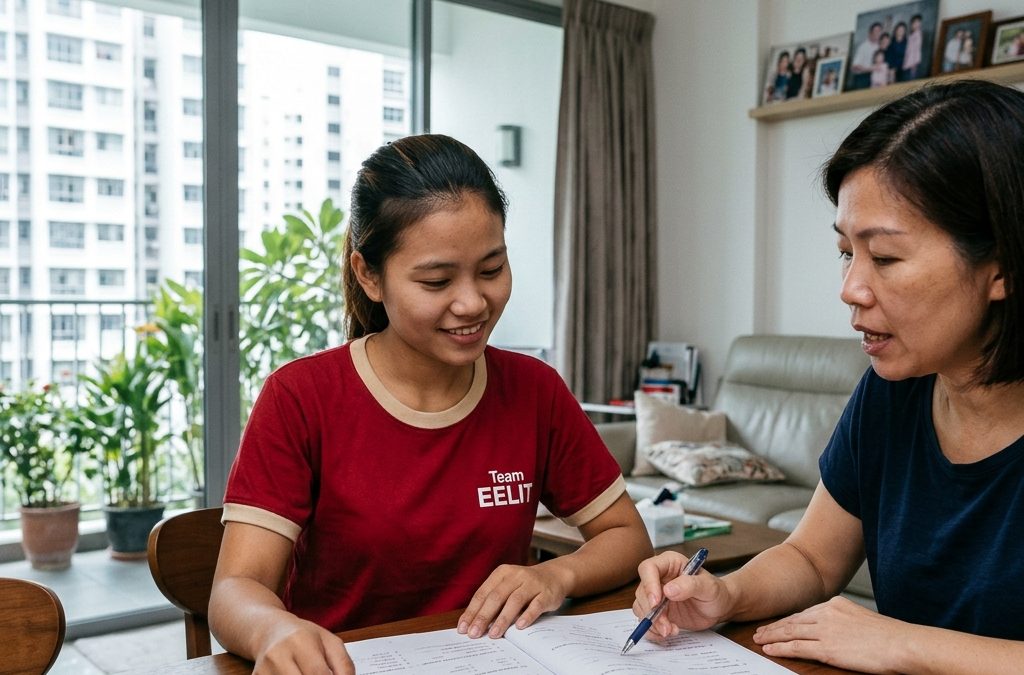
Choosing a Myanmar helper is an increasingly popular decision for Singaporean households, primarily due to their reputation for being hardworking, polite, and possessing a strong sense of loyalty. However, the most common hurdle for new employers remains the language barrier. In this guide, we will break down exactly how you can assess, train, and communicate with your Myanmar helper to ensure your household runs effectively. At EELIT Agency Pte. Ltd., we believe that communication is not just about vocabulary; it is about building a system of mutual understanding that protects your family and empowers your helper.
Understanding the 2026 MOM Framework and English Competency
The Ministry of Manpower (MOM) is constantly refining the requirements for Migrant Domestic Workers (MDWs) to ensure they can integrate safely into Singaporean homes. By 2026, there will be an even greater emphasis on the English Proficiency Test (EPT) and the Settling-In Programme (SIP). These regulations are designed to ensure that every helper entering a Singaporean home can at least understand basic safety instructions, read emergency contact numbers, and follow simple directions in English. For a Myanmar helper, who may have grown up in a rural area where English is rarely spoken, these new standards provide a necessary foundation. However, as an employer, you cannot rely solely on a certificate. You must understand that the English learned in a training center in Yangon is often “textbook English,” which sounds very different from the fast-paced, Singlish-infused English spoken in a busy Singaporean kitchen.
MOM’s direction reflects a shift toward higher quality caregiving. If your helper is expected to look after a newborn or an elderly parent with chronic conditions, her ability to read medication labels and understand “SOS” instructions is non-negotiable. At EELIT, we align our screening processes with these upcoming 2026 standards, ensuring that the candidates we present have a baseline of literacy that allows for further growth once they arrive at your doorstep.
Pre-Hiring Checks: How to Screen for Real Proficiency
When you look at a biodata, you will often see a rating for English proficiency. You must treat these ratings as a starting point rather than a final verdict. Many Myanmar helpers are shy and may undersell their abilities, or they may have memorized a script for their introduction video. To get a true sense of her readiness, the live interview is your most powerful tool. Avoid asking “Yes or No” questions. If you ask, “Can you cook?” she will say “Yes.” Instead, ask, “Tell me the steps you take to prepare a simple chicken soup.” This requires her to use verbs, nouns, and sequence markers like “first,” “then,” and “after that.”
Observe her listening skills during the video call. Does she look confused when you speak at a normal pace? A good candidate will ask you to repeat yourself or look for clarification. This is a sign of intelligence and honesty, which are far more valuable than a candidate who nods “Yes” to everything despite not understanding a word. At EELIT, we facilitate these interviews by encouraging employers to use visual aids—like showing a picture of a cleaning tool or a specific vegetable—to see if the helper can identify it in English. This practical testing is the only way to gauge how she will perform in a real-world Singaporean environment.
The First 30 Days: A Structured Training Plan
The first month is the most critical period for setting communication expectations. Do not expect your Myanmar helper to understand your entire household routine through verbal instructions alone. You need to create a visual environment. This starts with labeling. Use a masking tape and a marker to label everything in your kitchen and utility closet: “Bleach,” “Floor Cleaner,” “Dish Soap,” and “Washing Machine Powder.” Write the English word clearly. This constant visual reinforcement helps her link the physical object to the English term every time she reaches for it.
Structure your training in stages. In the first week, focus entirely on safety and location. She needs to know where the first aid kit is, how to use the fire extinguisher, and how to operate the door locks. In the second week, move to the kitchen. Instead of giving a long list of recipes, focus on “The Language of the Kitchen.” Teach her the names of the tools: ladle, spatula, colander, and tongs. By the third week, you can begin introducing more complex schedules, such as school bus timings or elderly exercise routines. This staggered approach prevents her from feeling overwhelmed, which is the primary cause of “helper burnout” and communication breakdown in the early stages.
Daily Communication Protocols and the ‘Yes’ Trap
In Myanmar culture, saying “No” to an elder or an employer can be seen as disrespectful. This leads to the “Yes Trap,” where a helper agrees to a task she doesn’t understand because she wants to please you. To break this cycle, you must change how you confirm understanding. Never ask, “Do you understand?” Instead, use the “Show and Tell” method. After giving an instruction, ask her, “Can you show me how you will do that?” or “Can you tell me what I just asked you to do?”
If you find that she is still struggling with specific words, use a dedicated communication notebook. This is a simple exercise book where you write the three most important tasks for the day in clear, block-letter English. She can then use a translation app to look up words she doesn’t know. Over time, she will recognize these words without help. Additionally, be mindful of your own speech. Singaporeans tend to speak very quickly and end sentences with “lah,” “lor,” or “meh.” While this is natural for us, it is incredibly confusing for a Myanmar helper who is trying to find the “root” English word in your sentence. For the first few months, try to speak in “Standard English”—subject, verb, object—without the extra fillers.
Bridging the Gap with Technology and Visual Aids
Technology is a bridge, but it should not be a crutch. While translation apps like Google Translate have improved their Burmese-to-English capabilities, they are not 100% accurate. Use them for single words or short phrases, but avoid translating entire paragraphs of instructions, as the grammar often becomes garbled and confusing. A better use of technology is taking photos and videos. If you want the living room arranged in a specific way, take a photo of it and send it to her phone. If you want her to use a specific amount of detergent for the laundry, take a short 10-second video of you measuring it out.
Another highly effective tool is the use of a “Home Manual” with icons. At EELIT, we often suggest that employers create a simple folder with pictures of common household items alongside their English names. For example, a picture of a “diaper” next to the word “Diaper.” If she is caring for a child, having a visual schedule with icons—a sun for morning, a plate for lunch, a bed for nap time—allows her to follow the routine even if her English vocabulary is still developing. This visual literacy builds her confidence, and as her confidence grows, her spoken English will naturally improve.
Managing Multi-Generational Households and Dialect Challenges
In many Singaporean homes, the helper’s primary interaction is with the elderly, who may speak a mix of Hokkien, Cantonese, or Teochew. This adds another layer of difficulty for a Myanmar helper who is already struggling with English. If your helper needs to communicate with a grandparent who doesn’t speak English, you must act as the primary translator for the first few weeks. Teach her “Essential Dialect Words” that relate to the elderly person’s needs: words for “pain,” “toilet,” “hungry,” “medicine,” and “shower.”
It is unfair to expect a Myanmar helper to learn both English and a Chinese dialect simultaneously without help. Create a “Sound Chart” where you write the English word, the Dialect word, and if possible, a phonetic Burmese translation for her to read. For example: “Water” – “Chui” (Hokkien). When the helper can meet the basic needs of the elderly in their own language, the friction in the household decreases significantly. This creates a more harmonious environment where the elderly person feels cared for, and the helper feels successful in her role.
Real-World Scenarios: Handling Emergencies and Mistakes
Communication is tested most during a crisis. You must have a “Red Alert” protocol. This should be a single page stuck to the refrigerator that lists emergency numbers: Police (999), Fire/Ambulance (995), your mobile number, and a neighbor’s number. Teach her the specific English phrases she needs for an emergency: “My employer’s mother fell down,” “There is a fire in the kitchen,” or “The baby has a high fever.” Practice these phrases with her once a month so they become muscle memory.
When mistakes happen—and they will—avoid reacting with anger, which causes a Myanmar helper to retreat into silence. Instead, use the mistake as a “Communication Audit.” Ask her, “What did you think I meant when I said X?” Often, you will realize that a specific word you used was the source of the confusion. For example, telling her to “toss” something might mean “throw it away” to her, while you meant “mix it” (like a salad). By identifying these linguistic mismatches, you can correct the vocabulary and ensure the mistake doesn’t happen again. This constructive approach builds a “psychologically safe” environment where she isn’t afraid to ask for clarification next time.
How EELIT Agency Supports Your Family’s Communication Journey
At EELIT Agency Pte. Ltd., we do not just hand over a passport and a helper; we facilitate a long-term working relationship. Our role begins long before the helper arrives in Singapore. We work with our training partners in Myanmar to emphasize practical English that is specific to Singaporean domestic life. We focus on the “Vocabulary of the Heart”—teaching helpers how to express their own needs, such as when they are feeling unwell or if they are confused about a task, which prevents many common misunderstandings.
After the helper is placed in your home, EELIT remains a resource for you. If you find a persistent communication wall that you cannot break through, our consultants can step in to mediate. Sometimes, a third-party explanation in the helper’s native Burmese can clarify an employer’s expectations in a way that “Standard English” cannot. We provide orientation guidelines that help you structure those first 30 days, taking the guesswork out of training. Our goal is to ensure that your Myanmar helper becomes a valuable extension of your family, capable of communicating clearly and performing her duties with excellence.
Building a Long-Term Bond Through Language
Communication is a two-way street that requires patience from the employer and effort from the helper. A Myanmar helper often brings a level of dedication and kindness that is hard to find elsewhere. By investing time in her English readiness—through proper screening, visual training, and clear daily protocols—you are not just teaching her a language; you are giving her the tools to succeed in her job and provide the best possible care for your loved ones. Remember that every “English-fluent” helper you see in Singapore today likely started exactly where your new helper is now. With the right support from an agency like EELIT and a structured approach at home, the language barrier will eventually disappear, leaving behind a relationship built on trust and mutual respect. Success with a Myanmar helper is a marathon, not a sprint, and the rewards of a loyal, capable caregiver are well worth the initial effort in communication training.
Connect with EELIT Placement Specialists
Speak directly with our senior placement consultants for personalized bio matching, MOM Work Permit processing, and household caregiving support across Singapore:
Corporate Headquarters Placement Consultation
Corporate HQ Priority WhatsApp: +65 9100 1610
Juliet (Senior Consultant): Chat with Juliet (+65 9168 2493) |
Joey (Senior Consultant): Chat with Joey (+65 8725 2891)
HQ Office Telephone (Hotline / Voice Call Only): +65 6320 3826
Islandwide Branch WhatsApp Lines
Orchard (Far East Shopping Centre): +65 9478 2786
Hougang: +65 8043 9823
Yishun: +65 8090 3168