
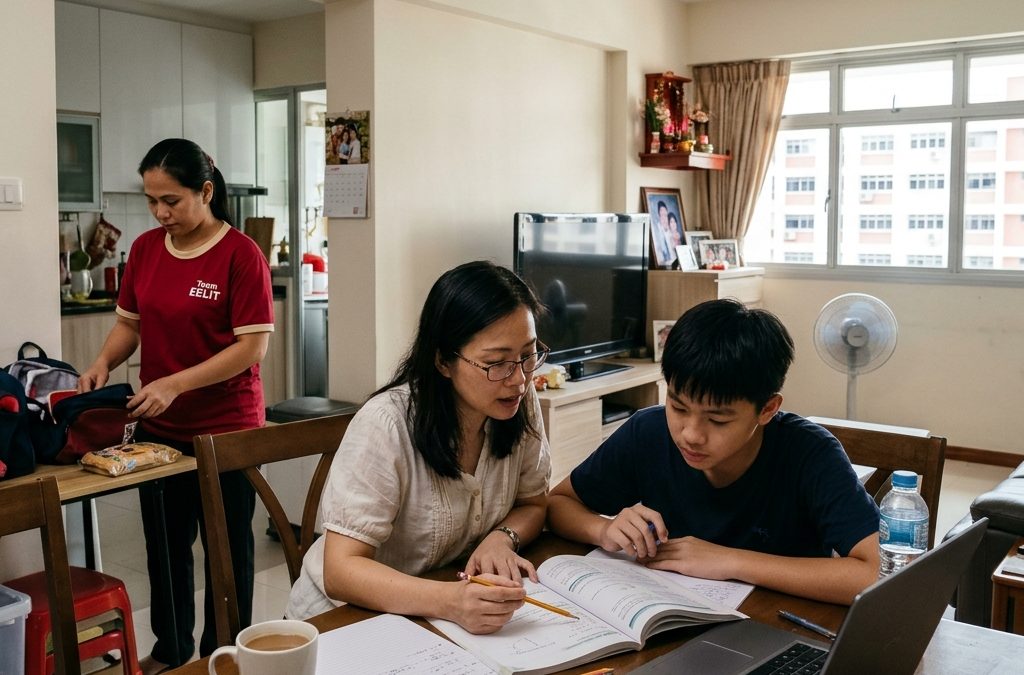
In the high-pressure environment of Singapore’s education system, exam season is often a period of collective family stress. From the Primary School Leaving Examination (PSLE) to the GCE O and A-Levels, the household atmosphere shifts, becoming focused on revision schedules, mock papers, and the pursuit of academic excellence. For families employing a Migrant Domestic Worker (MDW), the helper becomes a vital part of this ecosystem. However, a common pitfall for many working parents is accidentally shifting the emotional and developmental weight of parenting onto the helper during these busy months. At EELIT Agency Pte. Ltd., we believe that effective helper support should act as a scaffold for the household, allowing parents to focus exclusively on their child’s emotional well-being and academic guidance without the distraction of domestic chores. This guide provides an exhaustive look at how to navigate the exam season by utilizing helper support effectively while maintaining your role as the primary influence in your child’s life.
Understanding the 2026 MOM Framework and MDW Well-being
As we move toward 2026, the Ministry of Manpower (MOM) has introduced increasingly stringent guidelines regarding the mental health and physical well-being of Migrant Domestic Workers. These regulations are designed to ensure that the domestic workforce remains sustainable and that helpers are not subjected to burnout. During the exam season, it is easy for employers to overlook these boundaries in the name of academic emergency. However, the new framework emphasizes that an overworked helper is a liability to the safety and harmony of the home. The 2026 guidelines focus on mandatory rest days that cannot be compensated away indefinitely and the clear definition of work scopes.
When the household is in “exam mode,” your helper’s workload naturally shifts. There might be more meals to prepare, more frequent cleaning of study areas, or additional errands. It is essential to remember that while the children are staying up late to study, the helper should not be expected to match those hours. Fatigue leads to mistakes, and in a household with children, safety is paramount. Employers must ensure that their MDWs receive the stipulated eight hours of continuous sleep and that their rest days are respected. If you require extra help on a rest day during the peak PSLE weeks, this must be mutually agreed upon and compensated according to the latest MOM directives, ensuring the helper has had adequate downtime in the preceding weeks.
Defining the Boundary: Logistic Support vs. Parenting
The most important distinction to make during the exam season is between logistical support and parenting. Logistic support includes tasks that keep the house running—cooking, laundry, cleaning, and managing school supplies. Parenting, conversely, involves the emotional labor of encouragement, the intellectual labor of explaining difficult concepts, and the disciplinary labor of managing screen time or sleep schedules. Problems arise when parents, overwhelmed by their own work schedules, ask the helper to “make sure the child is studying” or “check if the homework is done.”
A helper is not a trained educator or a surrogate parent. Asking them to enforce study hours often places them in a position of conflict with the child, which can damage the household relationship. The helper’s role should be to create an environment where the child can study comfortably. This means having a quiet room, a clean desk, and a steady supply of nutritious food. The parent’s role is to sit with the child, discuss their anxieties, and provide the motivation they need. By outsourcing the chores to the helper, you free up your own mental bandwidth to be the parent your child needs during this stressful time.
Daily Protocols for a Successful Exam Season
To maximize the support of your helper without overstepping, you need a clear daily protocol. This protocol should be established at least two weeks before the intensive revision period begins. Start by reviewing the child’s exam timetable and identifying the “high-friction” times of the day. Usually, this is the window between 3:00 PM when the child returns from school and 7:00 PM when parents return from work. During this time, the helper’s primary responsibility should be the “Back of House” operations.
1. Nutritional Management: Instead of fast food or sugary snacks that lead to energy crashes, instruct your helper on specific meal prep. During exams, focus on brain foods such as steamed fish, walnuts, and fresh berries. Provide the helper with a weekly menu so they don’t have to ask for instructions every day. This ensures the child is well-fed without the parent having to manage every meal in real-time.
2. Environment Control: The helper should ensure the study area is decluttered every morning. A clean space reduces cognitive load. Furthermore, the helper can be tasked with managing noise levels—for example, avoiding vacuuming or using loud appliances during the child’s scheduled mock exam hours at home.
3. Uniform and Gear Readiness: There is nothing more stressful than a missing calculator or a dirty school uniform on the morning of a major paper. The helper’s checklist should include ensuring that all stationery is packed, the school bag is ready, and uniforms are pressed and laid out the night before. This eliminates morning friction and allows the parent to focus on giving the child a positive, calm send-off.
Real-World Scenarios: Navigating Common Exam Stressors
Consider the scenario of a Primary 6 student preparing for the PSLE. The tension in a Singaporean household during this time is palpable. The parent may feel tempted to ask the helper to monitor the child’s assessment book progress while the parent is at the office. This is a mistake. The helper may not understand the curriculum and may feel pressured to report “progress” just to please the employer, leading to a false sense of security. A better approach is to have the helper focus on the child’s physical comfort. If the child is tired, the helper can provide a warm drink or a healthy snack, and then inform the parent via a quick message that the child seems fatigued. This allows the parent to make the executive decision to let the child rest or push through, rather than putting the helper in an awkward “enforcer” role.
In another scenario, involving a teenager sitting for the O-Levels, the helper’s role might shift toward managing the needs of the younger siblings. Often, the exam candidate needs silence, but younger siblings may be loud or demanding. The helper can be directed to take the younger children to the playground or keep them occupied in a different part of the house. This protects the candidate’s study environment while ensuring the younger children do not feel neglected. Here, the parent is still the one setting the rules for the teenager’s study, but the helper is managing the domestic variables that would otherwise interrupt that study.
Maintaining Communication and Preventing Helper Burnout
Communication is the cornerstone of a successful employer-helper relationship, especially during high-stress periods. At EELIT, we often see household tensions peak during October and November. This is usually because the helper feels the weight of the family’s stress but doesn’t have a clear outlet or understanding of what is expected. It is helpful to have a “Pre-Exam Briefing.” Sit down with your helper and explain the importance of the upcoming weeks. Acknowledge that the house might be more tense and that their role in keeping things calm and fed is more valued than ever.
1. Clarity of Instructions: Use a whiteboard in the kitchen to list the daily schedule. Note down specific times for meals and any special requests. This reduces the need for the helper to constantly interrupt the parent or the child with questions.
2. Emotional Checking: Check in with your helper. Ask if they are managing the extra cooking or the changed schedule well. A simple “Thank you for your help during this busy week” goes a long way in maintaining morale. When a helper feels appreciated, they are more likely to go the extra mile to ensure the household runs smoothly.
3. Boundaries for the Child: Teach your children to remain respectful to the helper even when they are stressed. Exams are not an excuse for a child to be rude or to demand service beyond the helper’s usual duties. Parents must step in if they see the child treating the helper like a personal servant rather than a respected member of the household support team.
The EELIT Agency Advantage: Selecting and Training for High-Performance Homes
At EELIT Agency Pte. Ltd., we understand that every Singaporean family has a unique dynamic. Some households are academic-centric, while others focus on a balance of sports and studies. Our placement process goes beyond just matching skills; we match temperaments. For families with school-going children, we prioritize candidates who demonstrate high levels of organization, a calm demeanor under pressure, and an ability to follow complex schedules. These traits are essential during the exam season.
We provide our helpers with foundational training that covers more than just cleaning and cooking. We emphasize the importance of the domestic environment in child development. When you hire through EELIT, you are getting a partner who understands that their work in the kitchen and the laundry room is what allows the rest of the family to excel in the classroom and the boardroom. Our post-placement support also ensures that if tensions do arise during the exam period, we are available to mediate and provide guidance on how to re-adjust the household workload.
Furthermore, EELIT stays ahead of the curve regarding MOM regulations. We ensure that all our employers are fully briefed on the 2026 guidelines, helping you avoid legal pitfalls while maintaining a high standard of care for your MDW. We believe that a happy, well-rested helper is the secret weapon of any successful Singaporean student. By providing the right training and the right match, we help you ensure that the only thing your child has to worry about is their exam paper, and the only thing you have to worry about is being there for them.
Transitioning Out of Exam Mode
Once the final paper is submitted, the household should transition out of exam mode. This is the time to reward both the child and the helper. The helper has likely worked more intensely or handled more emotional tension than usual. Consider providing an extra day of rest or a small token of appreciation. It is also important to return to a normal domestic routine. If some chores were neglected in favor of exam prep, don’t expect the helper to fix everything in a single day. Gradually return to the standard household schedule.
This period of transition is also a good time for parents to reflect on how the support system worked. Did the helper have enough information? Were there points of conflict? Use these insights to refine your protocols for the next exam cycle. Remember, the goal of having a helper is to enhance the quality of family life. By using their support for logistics and keeping the parenting for yourself, you create a home environment that is not just academically productive, but emotionally resonant and supportive for everyone involved.
In conclusion, the exam season doesn’t have to be a period of household chaos. With a clear understanding of the legal framework, a sharp distinction between chores and parenting, and the right support from a professional agency like EELIT, you can navigate these months with confidence. Your helper is there to provide the foundation, but the pillars of guidance and emotional support must always come from the parents. This balance is the key to raising successful, well-adjusted children in Singapore’s competitive environment.
Connect with EELIT Placement Specialists
Speak directly with our senior placement consultants for personalized bio matching, MOM Work Permit processing, and household caregiving support across Singapore:
Corporate Headquarters Placement Consultation
Corporate HQ Priority WhatsApp: +65 9100 1610
Juliet (Senior Consultant): Chat with Juliet (+65 9168 2493) |
Joey (Senior Consultant): Chat with Joey (+65 8725 2891)
HQ Office Telephone (Hotline / Voice Call Only): +65 6320 3826
Islandwide Branch WhatsApp Lines
Orchard (Far East Shopping Centre): +65 9478 2786
Yishun: +65 8090 3168