
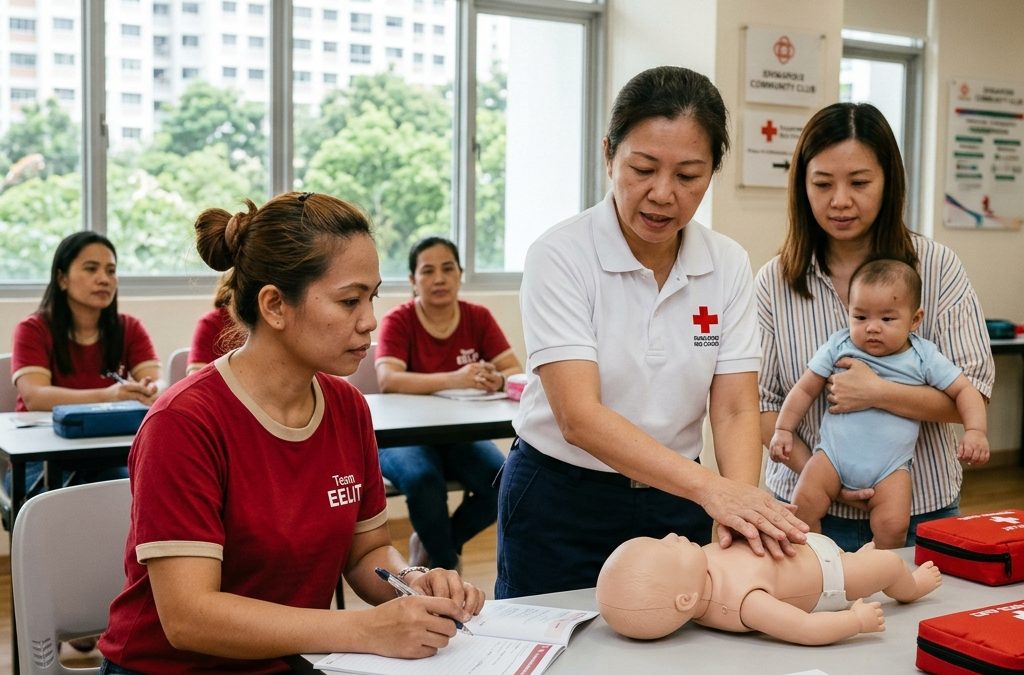
For many Singaporean families, a Migrant Domestic Worker (MDW) is far more than a household employee; she is the primary guardian of a child’s safety during the long hours when parents are at work. While general caregiving skills like bottle-feeding and diaper changes are fundamental, the ability to respond to a life-threatening emergency, specifically infant choking, is the most critical competency any helper can possess. At EELIT Agency Pte. Ltd., we recognize that a family’s peace of mind depends entirely on the helper’s readiness to act within those few seconds that define a medical outcome. This guide serves as an exhaustive manual for Singaporean employers to ensure their domestic helpers are not just aware of the risks but are fully trained and psychologically prepared to execute infant first aid with precision.
The Evolving Standards of Infant Care and Singapore’s 2026 Regulatory Framework
The Ministry of Manpower (MOM) has consistently signaled a shift toward professionalizing the domestic work sector, with a specific focus on specialized caregiving tracks. Looking toward 2026, Singapore is expected to implement even more stringent competency frameworks for MDWs who are tasked with caring for vulnerable populations, including infants and the elderly. These regulations move beyond basic housekeeping, emphasizing that a helper’s primary duty is the safety and well-being of their charges. At EELIT Agency, we have already begun aligning our training recommendations with these upcoming standards, ensuring that every helper we place understands the legal and moral weight of their role as a first responder in the home.
The Singaporean government’s focus on workplace safety and health (WSH) now extends more clearly into the domestic sphere. For an employer, this means that ensuring your helper is trained in infant first aid is no longer just a personal preference but a responsible fulfillment of your role as a household manager. A helper who lacks the skills to manage a choking incident puts the family at risk of emotional trauma and potential legal scrutiny regarding the adequacy of supervision and training provided within the home. This guide helps you bridge that gap by establishing clear, actionable protocols that meet the high expectations of the Singaporean medical and regulatory community.
Understanding Why Infants Are at High Risk of Choking
To train your helper effectively, she must first understand the biological reasons why babies are prone to choking. An infant’s airway is roughly the width of their pinky finger, meaning even a small piece of food or a tiny toy can cause a total obstruction. Furthermore, infants are in a developmental stage where they explore the world primarily through their mouths. This natural curiosity, combined with a lack of molar teeth for grinding food and an immature swallowing reflex, creates a high-risk environment. Your helper needs to know that “baby-proofing” is not a one-time event but a continuous process of vigilance.
We teach our helpers at EELIT Agency that choking is often a silent event. Unlike the movies, where a person might clutch their throat and cough loudly, a truly choking infant often cannot make any sound at all because their airway is completely blocked. This silence is the most dangerous sign. If a helper is in another room and doesn’t hear the baby, she might assume everything is fine. Therefore, the first rule of infant first aid in our protocol is constant visual supervision during all meal times and floor-play sessions. A helper must be taught that her eyes are the first line of defense against a choking hazard.
Recognizing the Signs: Partial vs. Complete Obstruction
A crucial part of the training is helping your domestic helper distinguish between a baby who is gagging and a baby who is choking. Gagging is a normal, noisy, and healthy part of learning how to eat. When a baby gags, they might cough, sputter, or even turn slightly red, but they are still moving air. In these instances, the helper should be instructed to stay calm and let the baby cough the item out. Intervening too early or trying to “sweep” the mouth can actually push the object deeper into the throat, turning a minor gagging incident into a life-threatening emergency.
Complete obstruction, or true choking, looks very different. Your helper must be trained to look for these specific indicators: the baby is unable to cry or make any sound, their face may turn blue or purple (cyanosis), they appear to be gasping without sound, or they have a look of panic on their face. If the baby is coughing weakly or making high-pitched noises, it indicates that the airway is partially blocked but air is still getting through. If the baby is silent and unable to breathe, the helper must initiate the infant first aid response protocol immediately without waiting for the parents to come home or for a doctor to answer the phone.
The Immediate Response Protocol: Five Back Blows and Five Chest Thrusts
When a helper identifies that an infant is choking, she must follow the “Five and Five” protocol recommended by the Singapore Red Cross and other international medical bodies. First, she should sit or kneel and lay the infant face down along her forearm, which should be resting on her thigh. She must support the infant’s jaw with her hand, taking great care not to put pressure on the soft tissue of the neck or to cover the baby’s mouth. The baby’s head should be lower than their chest, allowing gravity to assist in dislodging the object.
1. The helper should deliver five firm back blows using the heel of her hand. These strikes should land between the baby’s shoulder blades. Each blow should be a distinct attempt to dislodge the obstruction, rather than a continuous patting motion. If the object comes out, she stops immediately.
2. If the object remains, the helper must carefully turn the baby over so they are lying face up on her other forearm, again keeping the head lower than the chest. She will then perform five chest thrusts using two fingers placed in the center of the baby’s chest, just below the nipple line. These thrusts should be about one and a half inches deep and delivered at a rate of one per second.
3. This cycle of five back blows and five chest thrusts must be repeated continuously until the object is expelled or the infant becomes unconscious. At EELIT Agency, we emphasize that the helper must not attempt a “blind finger sweep” to find the object, as this often pushes the item further down the airway. She should only remove an object if it is clearly visible and easily reachable at the front of the mouth.
Daily Prevention Protocols: Creating a Safe Environment
While knowing how to respond is essential, preventing the incident is the ultimate goal. Employers should work with their helpers to establish a daily safety checklist. This includes a “floor sweep” where the helper crawls on her hands and knees to see the world from the baby’s perspective. Any small items—coins, buttons, hair ties, or dropped medication—must be cleared immediately. In Singaporean households where multi-generational living is common, elders might accidentally drop pills or small objects, so the helper must be the designated safety officer for the entire living space.
Toy safety is another critical area. Any toy that can fit through a toilet paper roll is a potential choking hazard for a child under three years of age. Your helper should be instructed to regularly check toys for broken parts or loose eyes and buttons. At EELIT Agency, we advise employers to provide their helpers with a specific “safety bin” where any broken or questionable toys are placed immediately for the employer’s review, rather than being left in the play area. This clear communication channel ensures that safety remains a collaborative effort.
Mealtime Safety and High-Risk Food Management
In Singapore, many choking incidents occur during meal times, often involving foods that are common in our local diet. A domestic helper must be trained on how to prepare food safely for an infant. For example, round foods like grapes, cherry tomatoes, or longan must always be cut lengthwise into thin quarters. Harder vegetables like carrots should be steamed until they are soft enough to be mashed between the tongue and the roof of the mouth. Hot dogs or sausages, which are the perfect shape to plug an infant’s airway, should be sliced into very small, non-circular pieces.
The helper should also be taught that “distracted eating” is a major risk factor. Babies should never be fed while they are crawling, running, or laughing. They should always be seated upright in a high chair, and the helper should be focused entirely on the feeding process rather than multitasking with housework. Additionally, the helper must understand that she should never force-feed a baby or rush them, as this can lead to an inhalation of food into the airway. Establishing these mealtime boundaries is a core part of the professional training we advocate for at EELIT Agency.
Establishing a Clear Emergency Communication Chain
In a crisis, panic is the greatest enemy. A domestic helper might feel hesitant to call emergency services, fearing they might get into trouble or that the cost of an ambulance is too high. It is the employer’s responsibility to debunk these fears. You must explicitly tell your helper: “If the baby is choking and you cannot get the object out, call 995 immediately. Do not call me first. Call the ambulance, then call me.” Every second spent trying to reach a parent on the phone is a second lost for the baby’s oxygen supply.
We recommend placing a clear, laminated emergency contact sheet on the refrigerator or in a prominent place in the kitchen. This sheet should include the home address in English (to read to the SCDF operator), the emergency number 995, the parents’ mobile numbers, and the contact for the nearest 24-hour pediatric emergency room. Practicing a “mock emergency call” with your helper can help her overcome the language barrier and the anxiety of speaking to authorities during a high-stress situation. This ensures that when she picks up the phone, her voice is steady and the information she provides is accurate.
Psychological Preparedness and Managing Helper Anxiety
Performing first aid on an infant is emotionally taxing. Many helpers may feel a deep sense of fear that they will hurt the baby if they hit them too hard during back blows. It is vital to explain that while the blows must be firm, they are necessary to save the baby’s life. A bruised back is a minor concern compared to an obstructed airway. Encouraging your helper and building her confidence is just as important as the technical training itself. When a helper feels trusted and empowered, she is more likely to remain calm and follow the protocols she has learned.
Furthermore, employers should discuss the “what-ifs” openly. If an incident occurs, the family should have a debriefing session. At EELIT Agency, we provide support for both the family and the MDW after any medical emergency. We believe that caring for the mental health of the helper after she has managed a crisis is essential for her continued success in your home. A helper who feels supported is a helper who will stay with your family for the long term, providing the stability and safety your child deserves.
How EELIT Agency Supports Your Family’s Safety Journey
Choosing the right domestic helper is the first step, but ensuring she is equipped for the realities of Singaporean parenting is where EELIT Agency Pte. Ltd. truly excels. We do not just facilitate a contract; we facilitate a relationship built on competency and trust. Our vetting process identifies candidates who show a natural aptitude for caregiving and a willingness to undergo rigorous training. We strongly encourage all our employers to enroll their helpers in certified Infant First Aid and CPR courses in Singapore, and we provide a list of accredited partners who offer these specialized sessions.
Our commitment to your family goes beyond the initial placement. We offer ongoing guidance on how to manage your helper’s performance and how to keep her skills sharp. Whether it is providing updated MOM guidelines or helping you navigate the complexities of a multi-generational household, EELIT Agency stands as your partner in home safety. We believe that a well-trained helper is the greatest gift an employer can provide for their child, and we are dedicated to making that a reality for every household we serve.
By following the protocols outlined in this guide and working closely with a reputable agency like EELIT, you are taking a proactive stance against one of the most common yet preventable causes of infant injury. Safety in the home is a collective responsibility, and with the right training, your domestic helper can become a highly skilled guardian, capable of protecting your most precious family members in their most vulnerable moments.
Connect with EELIT Placement Specialists
Speak directly with our senior placement consultants for personalized bio matching, MOM Work Permit processing, and household caregiving support across Singapore:
Corporate Headquarters Placement Consultation
Corporate HQ Priority WhatsApp: +65 9100 1610
Juliet (Senior Consultant): Chat with Juliet (+65 9168 2493) |
Joey (Senior Consultant): Chat with Joey (+65 8725 2891)
HQ Office Telephone (Hotline / Voice Call Only): +65 6320 3826
Islandwide Branch WhatsApp Lines
Orchard (Far East Shopping Centre): +65 9478 2786
Hougang: +65 8043 9823
Yishun: +65 8090 3168