
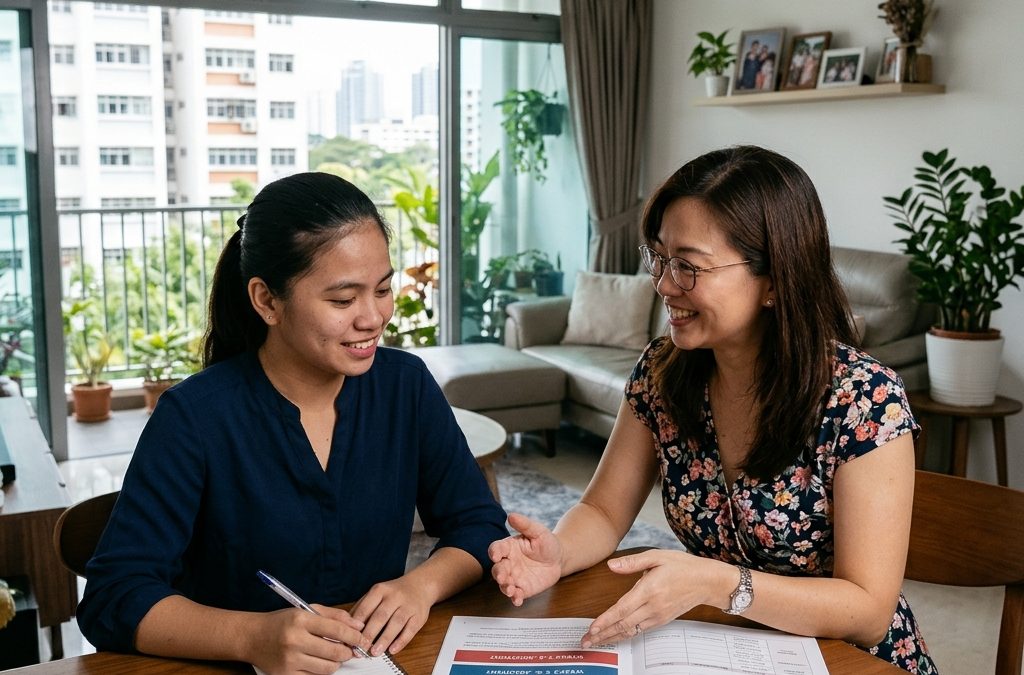
Bringing a first-time Migrant Domestic Worker (MDW) into a Singaporean household is a significant transition that requires more than just a room and a job description. For many families, this arrival represents a solution to the complex demands of modern life, from eldercare to childcare. However, for the helper arriving from a rural village in the Philippines, Indonesia, or Myanmar, the transition is a profound psychological and cultural shift. The first 90 days are the most critical period in any employment relationship. This is the window where the foundation of trust is built, or where the cracks of homesickness and anxiety begin to jeopardize the placement. At EELIT Agency Pte. Ltd., we have observed that successful households are those that approach maid onboarding as a structured framework rather than a series of trial-and-error moments.
Understanding the Psychology of the First-Time Helper
The first step in a successful onboarding process is recognizing the emotional state of a first-time helper. Most MDWs leaving their home country for the first time experience a specific type of culture shock that combines geographical displacement with the pressure of financial debt and family expectations. The anxiety of potentially failing her family back home, coupled with the unfamiliarity of high-rise living in Singapore, can be overwhelming. You might notice your helper being unusually quiet, appearing forgetful, or even shedding tears when she thinks she is not being watched. These are not signs of incompetence or lack of interest. Rather, they are natural physiological responses to extreme stress and a new environment.
To manage this, employers must shift their perspective. Instead of expecting immediate efficiency, focus on psychological safety during the first fortnight. A helper who feels safe and welcomed will eventually work faster and more accurately than one who is constantly paralyzed by the fear of making a mistake. The anxiety often stems from the unknown. By providing a clear roadmap of what her life will look like for the next two years, you remove the “fear of the dark” that many first-timers carry through their first month in Singapore.
The 2026 Regulatory Context and Singapore MOM Standards
The Ministry of Manpower (MOM) has continuously evolved the framework for MDW employment to ensure both employer protection and helper welfare. As we move toward 2026, the emphasis is increasingly on mental well-being and clear communication of terms. The mandatory Settling-In Programme (SIP) is just the starting point. Employers are now encouraged to conduct more frequent check-ins, especially regarding rest days and access to communication. Under current and upcoming guidelines, the mandatory rest day—which must be a day of actual rest—cannot be compensated away indefinitely. This regulation is designed specifically to prevent burnout and mitigate homesickness by allowing helpers to build a support network in Singapore.
Furthermore, the 2026 regulatory outlook suggests even stricter adherence to medical check-ups and mental health screenings. EELIT Agency stays ahead of these changes by ensuring all our first-time helpers undergo pre-deployment briefings that align with the latest MOM requirements. For employers, staying compliant means more than just paying the levy and providing insurance. It involves documenting the induction process and ensuring the helper understands her rights and responsibilities from the first hour she steps into your home.
Phase One: The First 7 Days – The Orientation and Basic Needs
- The first priority is her physical well-being and basic orientation. When she arrives, ensure she has a clean, private space to sleep and adequate food. Many helpers are too shy to ask for more food or to specify what they can or cannot eat. Be proactive in showing her where the pantry is and encouraging her to eat until she is full.
- Introduce the household members slowly. If you have a large multi-generational family, do not expect her to remember everyone’s names and specific preferences on the first day. Use a simple chart with names and photos if necessary.
- Safety is paramount. Show her how to use modern appliances, which may be entirely foreign to her. This includes induction cookers, high-end vacuum cleaners, and even the flushing mechanisms of toilets or the locks on the doors. Never assume knowledge. A first-timer might be too embarrassed to admit she has never seen a microwave before.
- Establish the communication channel. Discuss when she can call her family back home. Allowing a short call on the first night to inform her family she has arrived safely is one of the most effective ways to lower her immediate anxiety levels.
During this first week, your goal is not to have a perfectly clean house. Your goal is to ensure she knows she is in a kind environment. If she feels she can ask a question without being scolded, you have already won half the battle of onboarding.
Phase Two: Days 8 to 30 – Routine Building and Skill Assessment
Once the initial shock has worn off, the second phase focuses on establishing a sustainable daily routine. This is where many employers make the mistake of giving verbal instructions and expecting them to be memorized. For a first-time helper, a written schedule or a visual checklist is far more effective. It provides a reference point that she can consult when you are at work, reducing the anxiety of “forgetting” a task.
- Focus on one major skill area at a time. For example, dedicate the second week to laundry and ironing. Once she has mastered the settings on your washing machine and the way you like your clothes folded, move on to kitchen hygiene and cooking in the third week.
- Implement the “Show-Do-Check” method. First, you show her how to perform a task. Second, you let her do it while you watch. Third, you check her work later and provide constructive feedback. Avoid “why” questions like “Why did you do it this way?” which can sound accusatory. Instead, use “How” or “Let’s try” phrases to guide her toward your preferred method.
- Address homesickness head-on. By the end of the first month, the novelty of Singapore often wears off, and the reality of being away for two years sets in. This is usually when the first wave of true homesickness hits. Acknowledge it. Ask her about her children or her parents. Showing interest in her life back home validates her as a human being, not just a service provider.
It is also during this period that you must finalize the rest day arrangements. Consistent schedules help the helper look forward to a break, which is a powerful motivator during a long work week. EELIT Agency recommends setting a fixed Sunday or Saturday so she can plan her social life and attend religious services or skill-improvement courses.
Phase Three: Days 31 to 90 – Integration and Autonomy
By the second and third months, the helper should be familiar with the rhythm of your household. This phase is about transitioning from constant supervision to supervised autonomy. This is also the period where the most significant growth in the employer-helper relationship occurs. If she has survived the first 30 days without major conflict, she is likely to stay for the duration of her contract, provided the environment remains respectful.
- Grant small amounts of autonomy. Allow her to manage the grocery list for basic items or decide the sequence of cleaning tasks for the day. This builds her confidence and makes her feel like a trusted partner in the household management.
- Fine-tune her cooking skills. Many first-timers struggle with Singaporean flavors. If your family prefers specific styles of Chinese, Malay, or Indian cooking, consider enrolling her in a weekend cooking class or spending a Saturday afternoon teaching her the family recipes. Food is a major point of contention in many households; solving this early prevents long-term frustration.
- Review the employment contract and house rules together. Now that she understands the daily work, go back to the original agreement. Are there areas that need adjustment? Is she managing her phone usage well? Is she getting enough rest? Use this 90-day mark as a formal “probation review” that is supportive rather than punitive.
If there are performance issues, address them clearly. If she is doing well, offer praise. Positive reinforcement is often more effective than criticism for first-time MDWs who are eager to please but may be unsure if they are meeting your expectations.
Managing Common Stressors: Phones, Money, and Social Media
Three areas often cause friction in the first 90 days: mobile phone usage, financial management, and social media presence. In the modern era, a mobile phone is a helper’s lifeline to her support system, but it can also be a distraction. We recommend a balanced approach. Setting clear boundaries—such as no phone usage during active working hours or meal times, but full access during her rest periods—is essential. Do not confiscate the phone, as this often leads to resentment and a feeling of isolation, which worsens homesickness.
Regarding finances, many first-time helpers are unfamiliar with banking systems or may be pressured by family to send all their money home. Employers should ensure that salaries are paid via bank transfer to provide a clear paper trail, as per MOM recommendations. At EELIT Agency, we often advise employers to help their helpers set up a POSB/DBS account early on. This empowers the helper to manage her own savings and reduces the risk of financial disputes.
Social media is another area that requires a conversation. Explain your household’s privacy expectations early. For instance, she should not post photos of your children or the interior of your home on platforms like TikTok or Facebook. Most helpers will respect these rules if they are explained as a matter of family safety and privacy rather than a restriction on their personal freedom.
How EELIT Agency Supports Your Family Through the Transition
At EELIT Agency, we believe that our responsibility does not end once the helper arrives at your doorstep. We recognize that even with the best intentions, language barriers and cultural misunderstandings can occur. Our role is to act as a professional mediator during these first 90 days. We provide translation services to ensure that complex instructions are understood, and we offer counseling for helpers who are struggling with severe homesickness.
If you notice that your helper is not adjusting well despite following an onboarding framework, we encourage you to contact us. Sometimes, a third-party perspective from an agency counselor can identify a simple misunderstanding that the employer might have missed. We also provide employers with resources on cultural nuances—for instance, explaining why a helper might say “yes” even when she hasn’t fully understood an instruction (a common trait in many Southeast Asian cultures aimed at maintaining harmony).
Signs of Success: When the Onboarding is Working
How do you know if your onboarding framework is successful? There are several key indicators. First, the helper begins to take initiative without being asked. She might notice the milk is running low and add it to a list, or she might change a diaper before you prompt her. Second, she looks more relaxed. Her body language is less tense, and she interacts more naturally with your children or elderly parents. Third, she communicates her needs or mistakes honestly. When a helper feels she can tell you she accidentally broke a dish without being met with an angry outburst, you have achieved a level of trust that ensures long-term stability.
Ultimately, a first-time helper who is well-onboarded becomes an integral part of the family ecosystem. She is no longer a stranger in your home, but a skilled professional who understands your family’s unique needs. This transformation doesn’t happen by accident; it is the result of the deliberate, compassionate, and structured 90-day approach we have outlined here.
Hiring a domestic helper is a partnership. By investing time, patience, and clear communication in the first three months, you are not just managing an employee; you are building a support system that will allow your family to thrive. EELIT Agency is committed to walking this journey with you, providing the expertise and support needed to turn a new arrival into a long-term success story for your Singaporean household.
Connect with EELIT Placement Specialists
Speak directly with our senior placement consultants for personalized bio matching, MOM Work Permit processing, and household caregiving support across Singapore:
Corporate Headquarters Placement Consultation
Corporate HQ Priority WhatsApp: +65 9100 1610
Juliet (Senior Consultant): Chat with Juliet (+65 9168 2493) |
Joey (Senior Consultant): Chat with Joey (+65 8725 2891)
HQ Office Telephone (Hotline / Voice Call Only): +65 6320 3826
Islandwide Branch WhatsApp Lines
Orchard (Far East Shopping Centre): +65 9478 2786
Hougang: +65 8043 9823
Yishun: +65 8090 3168