
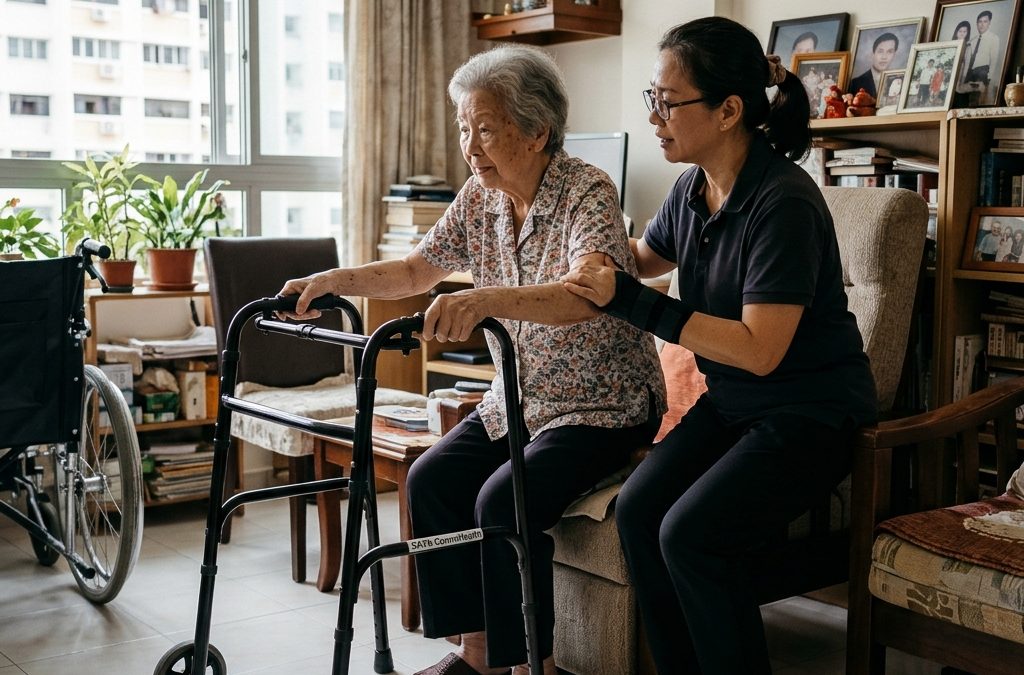
In the heart of Singaporean households, the safety of our aging parents is often the highest priority, yet the physical demands of daily care can take a hidden toll on both the senior and the migrant domestic worker. As a leading employment agency, EELIT Agency Pte. Ltd. recognizes that an eldercare maid is more than just a domestic helper; she is a specialized caregiver who must navigate the complex physical challenges of mobility and transfers within the confines of a typical HDB flat or condominium. This guide serves as a definitive resource for families to ensure that mobility assistance remains a safe, dignified, and injury-free process for everyone involved.
The Growing Physical Demands of Eldercare in Singaporean Homes
As our population ages, the complexity of care required at home has increased significantly. Many Singaporean families now find themselves in a position where they must manage seniors with limited mobility, often due to stroke, advanced arthritis, or neurodegenerative conditions like Parkinson’s disease. When an eldercare maid is hired, the primary expectation is that she will assist with transfers—moving the senior from the bed to a chair, or from a wheelchair to the toilet. However, without proper training and a deep understanding of body mechanics, these routine tasks carry a high risk of musculoskeletal injuries.
Injuries in the home setting are rarely the result of a single catastrophic event. Instead, they often stem from repetitive strain. For the domestic helper, this manifests as chronic lower back pain, shoulder strains, and wrist injuries caused by improper lifting. For the senior, incorrect transfer techniques can lead to skin tears, bruising, or the most feared outcome of all: a fall. In the context of an elderly person, a fall often leads to hip fractures, which can drastically reduce their quality of life and increase mortality rates. Therefore, mastering mobility techniques is a fundamental requirement for a safe home environment.
Understanding the MOM 2026 Framework and Regulatory Standards
The Ministry of Manpower (MOM) has been progressively tightening the standards for migrant domestic workers who are specifically tasked with caregiving duties. Looking toward 2026, the regulatory framework in Singapore is shifting to emphasize specialized competency. The government, in collaboration with the Agency for Integrated Care (AIC), is increasingly advocating for caregivers to undergo certified training modules before or shortly after they begin their employment. This is part of a broader national strategy to ensure that “aging in place” is a viable and safe option for the silver generation.
EELIT Agency stays ahead of these regulations by ensuring that our eldercare maids are prepared for these evolving standards. The MOM 2026 vision suggests that domestic workers will need more frequent skill assessments and that employers will be encouraged to utilize the Caregivers Training Grant (CTG) to upskill their helpers. By staying informed about these legal shifts, families can better appreciate why physical technique training is no longer an optional “extra” but a mandatory component of responsible employment. Ensuring your helper is trained in these specific areas protects the family from potential legal and financial liabilities that arise from workplace injuries occurring within the home.
The Foundation of Safe Transfers: Proper Body Mechanics
The first rule of mobility assistance is that the caregiver should never attempt to lift the senior’s entire body weight. Instead, the goal is to guide and support the senior’s own movement. Proper body mechanics for the eldercare maid start with a wide base of support. The helper should stand with feet shoulder-width apart to maintain balance. When preparing for a transfer, she must bend at the hips and knees rather than the waist, using the powerful muscles in her legs to provide leverage rather than relying on her back muscles.
Communication is the second pillar of safe body mechanics. Before any movement begins, the helper must clearly explain what is about to happen. Using a simple “one, two, three, stand” count ensures that both the caregiver and the senior move in synchronization. This prevents sudden jerks or resisted movements that can cause a loss of balance. Furthermore, the helper should always keep the senior as close to her body as possible during the transfer. This minimizes the length of the lever arm, reducing the amount of force required to maintain control of the senior’s center of gravity.
Environmental Assessment: Preparing the Singaporean Home
A safe transfer is impossible in a cluttered or poorly designed environment. Singaporean homes, while compact and efficient, often present challenges such as narrow doorways, high bed heights, or slippery bathroom tiles. To prevent injuries, the household must undergo a thorough environmental assessment. This starts with the flooring. All loose rugs and mats must be removed or replaced with non-slip versions that are firmly anchored to the ground. In the bathroom, the installation of high-quality grab bars is non-negotiable. These bars provide the senior with a point of stability, allowing them to assist the helper during the transfer process.
Lighting is another critical factor. Many falls occur during the night when a senior needs to use the bathroom. Installing motion-sensor lights along the path from the bedroom to the toilet can significantly reduce the risk of trips. Additionally, the height of the furniture plays a major role. If a bed is too high, the senior’s feet will not touch the ground, making it difficult to find purchase before standing. Conversely, if a sofa is too low, the helper must pull the senior upward with excessive force. Adjusting furniture heights or using firm cushions can make these daily transitions much safer for the eldercare maid to manage.
Step-by-Step Technique: The Sit-to-Stand Transfer
The sit-to-stand transfer is perhaps the most frequent movement performed in a household. To perform this safely, the helper should follow a standardized protocol. First, ensure the senior is sitting at the edge of the chair or bed, with their feet flat on the floor and tucked slightly back. This positions the center of mass over the feet, making it easier to rise. The helper should stand directly in front of the senior, blocking the senior’s knees with her own to prevent their legs from sliding forward.
The helper should then place her hands on the senior’s hips or use a gait belt—a sturdy strap worn around the senior’s waist that provides a secure handhold. The senior should be encouraged to push off the armrests of the chair rather than pulling on the helper’s neck or shoulders. As the senior leans forward (bringing their “nose over toes”), the helper assists them into a standing position using a smooth, upward motion. Once standing, the helper must remain in place until the senior has found their balance and is ready to move to the next location.
Advanced Techniques: Moving from Bed to Wheelchair
Transferring a senior from a bed to a wheelchair requires even more precision, especially if the senior has one-sided weakness from a stroke. The wheelchair should be positioned at a 45-degree angle to the bed on the senior’s stronger side. This allows the senior to lead with their strong leg, which provides more stability. Before the transfer begins, it is imperative that the wheelchair brakes are locked and the footrests are swung out of the way to prevent tripping.
The eldercare maid should assist the senior into a sitting position on the side of the bed and allow them to sit for a minute to ensure they do not feel dizzy—a condition known as orthostatic hypotension. Once ready, the helper uses the sit-to-stand technique to help the senior rise. Instead of walking, the senior pivots on their feet until their back is toward the wheelchair. The helper then slowly lowers them into the seat, ensuring the senior reaches back for the armrests before sitting down. This controlled descent prevents the senior from “plopping” into the chair, which can cause spinal compression or skin shearing.
The Role of Assistive Devices and Technology
In many cases, physical strength alone is not enough to guarantee safety. This is where assistive devices become essential. For seniors with significant mobility issues, the use of a mechanical hoist or a stand-assist lifter can completely remove the physical strain from the eldercare maid. While these devices require more space, they are becoming increasingly common in Singaporean homes as families prioritize long-term health. For more mobile seniors, simple tools like slide sheets can make repositioning in bed much easier, reducing the friction that leads to skin breakdown.
EELIT Agency encourages employers to view these devices as investments rather than expenses. A gait belt, for instance, is an inexpensive tool that significantly improves the helper’s grip and control during a transfer. When a helper is equipped with the right tools, her confidence increases, and the senior feels more secure. This mutual sense of safety is vital for maintaining a positive relationship between the caregiver and the care recipient, as it reduces the anxiety often associated with movement.
Managing Resistance and Cognitive Challenges
Mobility becomes significantly more complex when the senior has dementia or cognitive impairment. In these scenarios, the senior may resist movement, become agitated, or forget the steps of a transfer halfway through the process. An eldercare maid must be trained in “person-centered care” to handle these situations. This involves using a calm, soothing voice and avoiding forceful movements that could trigger a “fight or flight” response in the senior.
If a senior is resisting a transfer, the best approach is often to stop, wait a few minutes, and try again. Forcing a transfer on a resisting senior is a leading cause of injury for both parties. Helpers should be taught to look for non-verbal cues of pain or discomfort that might be causing the resistance. Sometimes, something as simple as a poorly fitting shoe or a cold floor can make a senior unwilling to stand. By addressing the underlying cause of the resistance, the helper can facilitate a much smoother and safer transfer.
Emergency Protocols: What to Do if a Fall Occurs
Despite the best preparations, falls can still happen. The most important rule for an eldercare maid is: do not try to catch a falling senior. Attempting to stop a fall in progress often results in both the helper and the senior crashing to the ground, leading to more severe injuries. Instead, the helper should try to guide the senior’s fall, protecting their head and lowering them as gently as possible to the floor.
Once the senior is on the floor, the helper must not immediately try to pull them back up. The senior should be assessed for pain, visible injuries, or signs of a head injury. If the senior is unable to get up or is in significant pain, the helper must call for emergency medical services immediately. EELIT Agency trains its helpers to stay calm in these situations and to follow a specific check-list before attempting any post-fall recovery. Having a clear emergency protocol ensures that a minor incident does not escalate into a medical crisis due to improper handling.
How EELIT Agency Supports Singaporean Families
At EELIT Agency Pte. Ltd., we understand that the success of home-based eldercare depends on the perfect match between the family’s needs and the helper’s skills. We don’t just provide domestic workers; we provide caregivers who have been screened for their aptitude and experience in elderly care. We recognize that every household in Singapore has different requirements, whether it is caring for a mobile senior who just needs a steadying hand or a bedbound patient requiring total transfer assistance.
Our support doesn’t end when the helper arrives at your home. We provide guidance on where to find the best training courses in Singapore, including those covered by the Caregivers Training Grant. We also offer advice on home modifications and the selection of assistive devices. By choosing an agency that specializes in eldercare, families can rest assured that their helper has the foundational knowledge necessary to maintain a safe environment. We act as a partner in your caregiving journey, ensuring that your eldercare maid is well-equipped to handle the physical demands of her role for the long term.
Conclusion: Building a Culture of Safety at Home
Preventing injuries during mobility and transfers is a continuous process that requires the right skills, the right environment, and the right mindset. For Singaporean families, the goal is to create a home where the elderly can move with confidence and where the eldercare maid can perform her duties without fear of physical exhaustion or injury. This is achieved through a combination of professional training, ergonomic awareness, and the use of appropriate technology.
By following the techniques outlined in this guide and working with a dedicated partner like EELIT Agency, you are doing more than just hiring a helper; you are implementing a comprehensive safety strategy for your home. Remember that physical care is a skill that must be practiced and refined. As your senior’s needs change, so too must the techniques used by your helper. With patience, proper equipment, and the right support system, you can ensure that your loved ones receive the highest quality of care in the safety and comfort of their own home.
Connect with EELIT Placement Specialists
Speak directly with our senior placement consultants for personalized bio matching, MOM Work Permit processing, and household caregiving support across Singapore:
Corporate Headquarters Placement Consultation
Corporate HQ Priority WhatsApp: +65 9100 1610
Juliet (Senior Consultant): Chat with Juliet (+65 9168 2493) |
Joey (Senior Consultant): Chat with Joey (+65 8725 2891)
HQ Office Telephone (Hotline / Voice Call Only): +65 6320 3826
Islandwide Branch WhatsApp Lines
Orchard (Far East Shopping Centre): +65 9478 2786
Hougang: +65 8043 9823
Yishun: +65 8090 3168