
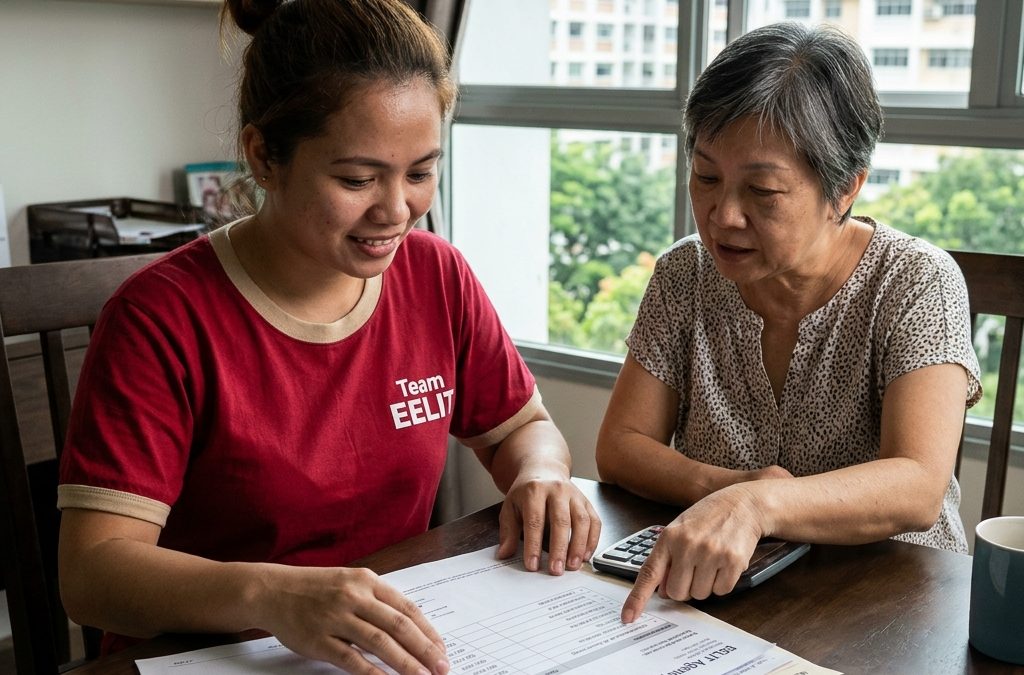
The fee paperwork that comes with hiring a migrant domestic worker in Singapore confuses plenty of first-time employers, and the numbers rarely sit where families expect them. For many Singaporean families, particularly those balancing the needs of young children and elderly parents, the lack of clarity regarding maid agency fees singapore is a major source of stress. At EELIT Agency Pte. Ltd., we believe that transparency is the foundation of a successful employment relationship. When you understand exactly where every dollar goes, you can make informed decisions that benefit both your household budget and the well-being of the person coming into your home to help. This guide provides an exhaustive breakdown of every line item you will encounter, updated for the 2026 regulatory environment, ensuring you are never caught off guard by hidden costs or ambiguous terminology.
The Regulatory Framework of 2026 and Fee Transparency
The Ministry of Manpower (MOM) has consistently moved toward a more regulated and transparent fee structure to protect both employers and domestic workers. The rules enforced during 2026 are tighter than what many employers remember from earlier placements. MOM mandates that all employment agencies provide a written breakdown of all fees charged to both the employer and the worker. That breakdown is a legal requirement, and it exists so families can see how much of the invoice is recruitment cost against administrative services.
One of the most critical aspects of the 2026 framework is the strict enforcement of fee caps on what an agency can charge a domestic worker. Agencies are generally restricted to charging the worker no more than one month of her salary for each year of the work permit, capped at a maximum of two months of salary. For you as an employer, understanding this cap is vital because any “placement fee” or “loan” you pay upfront is essentially an advance on the helper’s salary. If an agency is charging the worker significantly more than this, it is a red flag regarding their ethical practices and legal compliance.
Furthermore, MOM now requires a more detailed itemization of the “Service Fee” charged to the employer. This fee must be clearly separated from third-party costs like insurance, medical checkups, and government levies. This prevents agencies from hiding high service margins inside a lump sum. At EELIT Agency, we have always championed this level of detail because it allows our clients to see the value we provide in sourcing, screening, and documentation management.
Understanding the Agency Service Fee
The Service Fee is the primary revenue source for the employment agency. It covers the professional labor and overhead involved in bringing a helper into your home. While it can vary significantly between agencies, it generally encompasses several key functions. First is the sourcing and screening process. This involves working with overseas partners to identify candidates, conducting initial interviews, and verifying the worker’s history and references. A reputable agency spends significant time ensuring that a helper’s skills match your specific family needs, whether that is specialized elderly care or experience with newborns.
Second, the service fee covers the administrative heavy lifting. This includes the application for the In-Principle Approval (IPA), communicating with embassies, and ensuring that all paperwork complies with the latest Singaporean laws. The logistics of coordinating arrival, arranging transport from the airport, and managing the initial settling-in process are also part of this fee. When you see a very low service fee, you should ask what is being sacrificed. Often, lower fees mean less rigorous screening or a lack of post-deployment support, which can lead to a higher likelihood of a “mismatch” and the subsequent need for a replacement.
Third, the service fee often includes a limited number of “replacements” within a certain timeframe. For example, if the employment relationship does not work out within the first six months, the agency might waive the service fee for a second hire. It is crucial to read the fine print here to see if this covers only the agency’s service fee or if you will still be responsible for the third-party costs of the new helper, such as her airfare and medical screening.
The Placement Fee and the Salary Loan
The term “Placement Fee” is often used interchangeably with the “Maid Loan,” but they are essentially the same financial mechanism from different perspectives. This is perhaps the most misunderstood line item in the entire hiring process. In most cases, the domestic worker does not have the funds to pay for her own training, medical exams in her home country, or her airfare to Singapore. To cover these, the Singapore agency (and their overseas partner) pays these costs upfront. This total amount is then considered a “loan” to the worker.
As the employer, you pay this loan amount to the agency at the start of the contract. You then recoup this money by deducting a portion of the helper’s salary over the first few months of her employment. It is important to note that this is not an additional cost to you in the long run; it is an advance. However, it represents a significant upfront cash outlay. By 2026, the industry has moved toward more standardized loan amounts, but they still vary depending on the worker’s country of origin. For example, Filipino helpers often have lower loan amounts compared to those from Indonesia or Myanmar due to different government regulations in those countries regarding recruitment costs.
When reviewing your contract, ensure the loan amount is clearly stated and matches the deductions you will be making. Transparency here is essential for maintaining a good relationship with your helper. If she arrives and finds that her deductions are higher than what she was told in her home country, it creates immediate friction and distrust. EELIT Agency ensures that all parties are perfectly aligned on the loan repayment schedule before the worker even boards her flight.
Mandatory Government and Third-Party Costs
Beyond what the agency charges, there are several mandatory costs mandated by the Singapore government. These are non-negotiable and apply regardless of which agency you choose. The first is the Work Permit application and issuance fee. As of current regulations, the application fee is $35 and the issuance fee is $35. While small, these must be accounted for in the itemized list.
The Settling-In Programme (SIP) is another mandatory cost for all first-time domestic workers in Singapore. This is a one-day orientation program that covers safety, rights and responsibilities, and an introduction to Singaporean culture. The cost is approximately $75. This is a vital investment as it helps the worker understand the legal and social context of her new job, reducing the risk of accidental rule-breaking or workplace accidents.
Medical examinations are a recurring cost. Upon arrival, every helper must pass a medical checkup to ensure she is fit for work and free from infectious diseases. The initial checkup usually costs between $60 and $100 depending on the clinic. Following this, she will need to undergo a Six-Monthly Medical Examination (6ME) throughout her employment. Some agencies include the first medical exam in their package, while others list it as a separate reimbursement. You must clarify this to avoid double-paying.
Insurance and the Security Bond
In Singapore, it is a legal requirement for employers to purchase medical and personal accident insurance for their migrant domestic workers. The 2026 standards require a minimum medical coverage that has increased over the years to protect employers from high hospital bills. Currently, the minimum coverage for inpatient care and day surgery is $60,000 per year. While you can opt for the minimum, many families choose higher tiers of insurance for better peace of mind, especially if they are hiring a helper to care for someone with high-needs who might accidentally cause injury.
In addition to insurance, a $5,000 security bond must be furnished to the Ministry of Manpower. You do not have to pay $5,000 in cash. Instead, most employers purchase a “bond protector” or an insurance guarantee that covers this amount for a small premium (usually around $50 to $100). This bond is a guarantee that you and your helper will comply with the Work Permit conditions. If the helper goes missing or if you fail to pay her salary, the bond may be forfeited. Reputable agencies like EELIT will handle the purchase of these insurance policies and the bond guarantee as part of the onboarding process.
The Impact of the Helper’s Country of Origin
When comparing maid agency fees singapore, you will notice that the total cost fluctuates based on whether the helper is from the Philippines, Indonesia, Myanmar, or another MOM-approved source country. These differences are largely driven by the specific requirements of the respective home country embassies. For example, the Philippine Overseas Employment Administration (POEA) and the Overseas Workers Welfare Administration (OWWA) have specific requirements, including mandatory insurance that must be paid to the Philippine government, which can add several hundred dollars to the total package.
Indonesia also has its own set of requirements, often involving specific training certifications that must be verified. Myanmar, while often having lower embassy-related fees, may have higher logistics costs depending on the specific region the worker is sourced from. At EELIT, we provide a comparative breakdown so you can see why an Indonesian helper might have a different upfront cost compared to a Filipino helper. This allows you to choose a candidate based on their skill set and your budget, with full knowledge of the financial implications.
Transfer Helpers vs. New Helpers: Cost Differences
A common question families ask is whether it is cheaper to hire a “Transfer Helper” (someone already in Singapore who has finished or is terminating her current contract) versus a “New Helper” from abroad. From a fee perspective, transfer helpers are often perceived as cheaper because there are no international airfares or overseas recruitment costs involved. The “loan” or placement fee is typically much lower or even non-existent for a transfer helper.
However, the agency service fee for a transfer helper can sometimes be similar to that of a new helper. This is because the agency must still conduct thorough background checks on the reasons for the transfer, manage the transfer of the work permit between employers, and facilitate the interview process. While you save on the upfront loan, you may pay a premium for the worker’s experience and the fact that she is already acclimated to Singapore. Furthermore, transfer helpers often command a higher monthly salary than new arrivals. Over a two-year contract, the higher salary of an experienced transfer helper might actually exceed the total cost of a new helper, even after accounting for the new helper’s arrival fees.
Daily Protocols and Ongoing Monthly Costs
Once the helper has arrived and the initial agency fees are paid, your financial commitment shifts to monthly recurring costs. The most obvious is the salary, which must be paid on time and in full. We highly recommend using bank transfers rather than cash to maintain a clear record of payment, which is a requirement that has become standard practice under 2026 guidelines.
Then there is the Foreign Domestic Worker Levy. The standard levy is $300 per month, but many Singaporean families qualify for the concessionary rate of $60 per month. You are eligible for this lower rate if you have a child below 16 years old, an elderly family member above 67, or a person with disabilities living at the same address. This levy is paid directly to the government via GIRO and is not part of the agency fees, but it is a critical part of your monthly “maid budget.”
Finally, do not forget the “hidden” monthly costs: food, utilities, and basic toiletries. While not strictly “fees,” they are part of the financial responsibility of being an employer. A common protocol in Singapore is to provide a food allowance (if she cooks her own meals separately) or to simply include her in the family meals. Budgeting an extra $200 to $300 per month for these expenses is a realistic approach for most households.
Red Flags in the Agency Fee Structure
In your search for the right agency, you must be vigilant against unethical pricing practices. A major red flag is any agency that refuses to provide a detailed, itemized quote. If they insist on a “package price” without explaining what is included, they may be hiding excessive markups or omitting mandatory costs that you will be asked to pay later. Another red flag is an unusually high maid loan that exceeds the two-month salary cap. That arrangement breaks MOM regulations outright and drags the employer into a salary dispute that is expensive to unwind.
Be wary of agencies that offer “guaranteed unlimited free replacements.” Often, these agencies have a high turnover rate because they do not screen their helpers properly. The “free” replacement might save you the agency service fee, but you will still lose money on the time spent retraining a new helper and the administrative costs of the new work permit. A good agency focuses on getting the match right the first time, rather than offering endless replacements as a safety net for poor screening.
How EELIT Agency Supports Your Family
At EELIT Agency Pte. Ltd., we approach the hiring process as a partnership. We know that hiring a helper brings a new person into your private family space, and that responsibility shapes how we quote and explain every fee. Our fee structure is designed to be 100% transparent from the very first consultation. We provide a clear document that separates our service fees, the helper’s loan, and all mandatory government costs. There are no “hidden surprises” three weeks into the application process.
Our support goes beyond just paperwork. We provide detailed counseling and orientation for both the employer and the helper to ensure expectations are aligned. If a challenge arises during the employment period, our team is available to mediate and provide guidance. This reduces the emotional and financial cost of a failed employment relationship. We also stay updated on every minor change in MOM policy, so you don’t have to spend your weekends reading government circulars. By choosing EELIT, you are investing in a professional service that values the long-term stability of your household.
Conclusion: The True Value of Clear Pricing
Reading a fee schedule properly protects both households and helpers, and clear pricing matters far more than a discounted headline figure. When the costs are clear, the employer feels secure, and the helper feels treated fairly. By breaking down the service fees, the salary loans, and the mandatory government requirements, you can see that the total cost of hiring a domestic worker is a combination of administrative professional services and necessary regulatory compliance. As you move forward with hiring help for your family, use this guide as a checklist. Demand transparency, ask the hard questions about loan structures, and choose an agency that prioritizes ethical placement. In the long run, the peace of mind that comes from a fair and transparent hiring process is worth every cent of the investment.
Connect with EELIT Placement Specialists
Speak directly with our senior placement consultants for personalized bio matching, MOM Work Permit processing, and household caregiving support across Singapore:
Corporate Headquarters Placement Consultation
Corporate HQ Priority WhatsApp: +65 9100 1610
Juliet (Senior Consultant): Chat with Juliet (+65 9168 2493) |
Joey (Senior Consultant): Chat with Joey (+65 8725 2891)
HQ Office Telephone (Hotline / Voice Call Only): +65 6320 3826
Islandwide Branch WhatsApp Lines
Orchard (Far East Shopping Centre): +65 9478 2786
Yishun: +65 8090 3168