
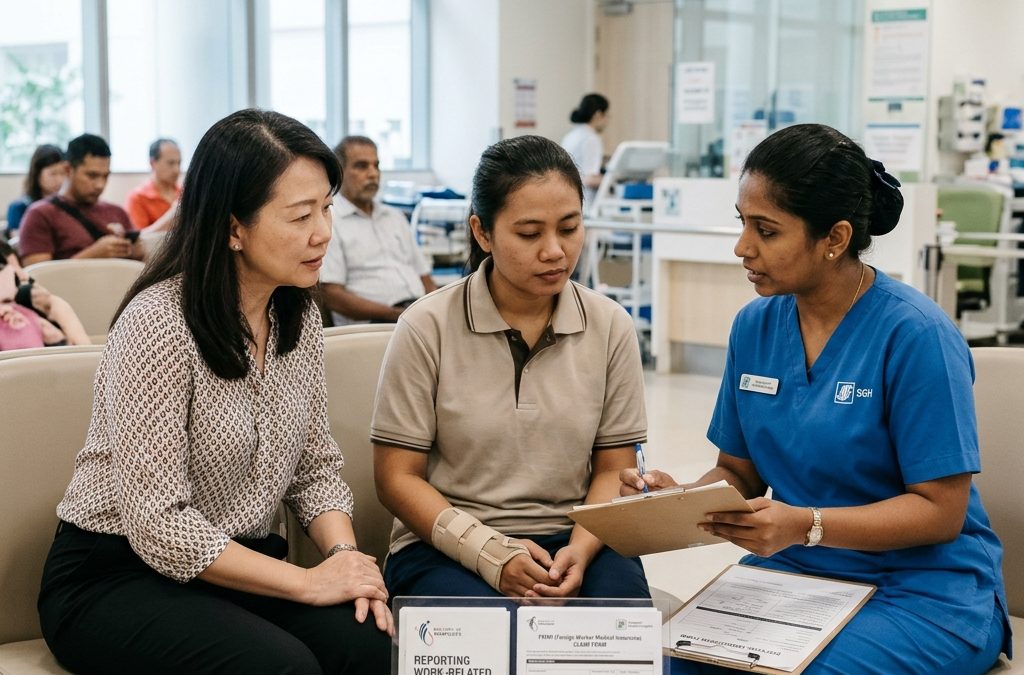
When a medical emergency strikes your household involving your Migrant Domestic Worker (MDW), the initial shock often gives way to a wave of administrative confusion. In the high-pressure environment of a Singaporean home, where your helper is frequently the primary caregiver for aged parents or young children, her sudden incapacitation creates a double crisis. You are not only concerned for her well-being as a member of your household but are also suddenly thrust into a complex web of Ministry of Manpower (MOM) regulations, hospital billing cycles, and insurance claim requirements. Managing these moving parts requires more than just a cool head; it requires an intimate knowledge of the Maid Insurance SG landscape and the latest legislative updates governing employer obligations.
Immediate Action: Navigating the First Golden Hour of a Medical Emergency
The moment you realize your helper requires urgent medical attention, your primary focus must be clinical rather than administrative. If the situation is life-threatening—such as signs of a stroke, severe chest pain, or a major fall—dial 995 immediately for an SCDF ambulance. It is important to note that SCDF ambulances will convey patients to the nearest designated restructured hospital. You do not have a choice of hospital in an emergency 995 call. For non-life-threatening but urgent situations, such as a deep laceration or high fever with disorientation, you may choose to take her to a 24-hour clinic or a hospital Accident and Emergency (A&E) department yourself.
Upon arrival at the hospital, you must have your helper’s original Work Permit (WP) card or a very clear digital copy available on your phone. The hospital registration staff will use this to verify her identity and her status as a foreigner. In Singapore, MDWs are considered “non-resident” patients. This means they do not qualify for the government subsidies that Singapore citizens or Permanent Residents receive. You should be prepared for the fact that hospital charges will be at the higher “Private” or “Non-Resident” rates, even in public restructured hospitals like Singapore General Hospital (SGH) or Tan Tock Seng Hospital (TTSH).
During the admission process, the hospital will ask for a deposit. This is where your Maid Insurance SG policy becomes vital. Most hospitals will ask for a Letter of Guarantee (LOG) from the insurer to waive or reduce the upfront cash deposit. However, obtaining an LOG takes time and usually only happens during office hours. If the emergency occurs at 2:00 AM on a Sunday, you should be prepared to pay a standard admission deposit via credit card, which can range from $1,000 to $5,000 depending on the nature of the ward and the severity of the condition.
The 2026 MOM Framework: Understanding Your Financial Liability
The Ministry of Manpower has significantly updated the requirements for MDW medical insurance to better protect both the employer and the worker. As of the latest 2026 regulations, all employers are required to maintain a minimum medical insurance coverage of $60,000 per year for their helper. This is a substantial increase from the older $15,000 limit, reflecting the rising costs of tertiary healthcare in Singapore. This $60,000 limit is designed to cover the majority of inpatient hospital bills and day surgeries.
However, the 2026 framework introduces a co-payment element. For bills that exceed a certain threshold (usually the first $15,000), the insurer pays a significant portion, but there may be a 25% co-payment shared between the employer and the worker, or solely borne by the employer depending on the specific policy rider. At EELIT Agency, we always advise our clients to look beyond the basic mandatory coverage. A “basic” policy might meet legal requirements but can leave an employer with thousands of dollars in out-of-pocket expenses if a major surgery is required. Selecting a comprehensive Maid Insurance SG plan with a “waiver of co-payment” rider is often the most prudent financial decision a household can make.
It is also essential to understand that under the Employment of Foreign Manpower Act, the employer is legally responsible for the cost of the MDW’s medical treatment. You cannot pass these costs to the helper if they are related to her employment or general illness. While the insurance helps mitigate this risk, any amount that the insurance does not cover—whether it is the deductible, the co-payment, or costs exceeding the $60,000 limit—remains the legal responsibility of the employer. This is why having a high-limit policy is no longer just a recommendation; it is a critical shield for your family’s savings.
Hospital Admission and the Role of the Letter of Guarantee
Once your helper is admitted, the administrative bridge between the hospital and your insurance provider must be built. A Letter of Guarantee (LOG) is a document issued by the insurer to the hospital, promising to pay the covered portion of the medical bill. If an LOG is accepted, the hospital will bill the insurer directly, and you will only be responsible for the “excluded” items, such as telephone charges, extra meals, or specific non-medical supplies.
To secure an LOG, you must contact your insurance provider’s emergency hotline or your employment agency immediately. You will need to provide the hospital’s admission note or a memo from the attending physician stating the diagnosis and the estimated cost of treatment. Be aware that insurers will not issue an LOG for conditions that are excluded from the policy, such as pre-existing conditions that were not declared, cosmetic procedures, or psychiatric treatment. If the insurer suspects the condition is pre-existing and was not covered under the initial waiting period, they may decline the LOG, forcing you to pay the full bill upfront and claim via reimbursement later.
If you find yourself in a situation where the hospital does not accept the LOG or the insurer is slow to respond, you must keep every single original receipt, inpatient discharge summary, and detailed itemized bill. In Singapore’s healthcare system, the “itemized bill” is different from the “tax invoice.” The insurer requires the itemized breakdown to see exactly what medicines and procedures were administered to ensure they fall within the policy coverage.
Mandatory MOM Reporting: Timelines and Legal Compliance
Not every medical emergency requires a report to the Ministry of Manpower, but missing a mandatory report can result in heavy fines or the revocation of your employer’s license. If the medical emergency is the result of a work-related accident, you must report the incident to MOM via the iSubmit portal. Under the Work Injury Compensation Act (WICA), any accident that results in the MDW being hospitalized for at least 24 hours or being granted more than 3 days of medical leave must be reported within 10 days of the occurrence.
Even if the emergency is not work-related—for example, a sudden case of appendicitis or a viral infection—there are still reporting considerations. If the illness results in the helper being unable to perform her duties for a prolonged period, or if the medical condition is one that is communicable and poses a public health risk, MOM must be kept informed. In the unfortunate event that a medical emergency leads to permanent disability or death, the reporting requirements are immediate, and the police must also be notified if the death occurs outside of a hospital setting.
For most families, the paperwork involved in an MOM report is daunting. You will need to provide a clear account of what happened, the medical documents from the hospital, and details of your insurance coverage. This is where the support of a licensed agency becomes invaluable. We often step in to help families navigate the iSubmit portal and ensure that the narratives provided are accurate and comply with the latest WICA guidelines, preventing unnecessary legal complications for the employer.
The Claims Process: Avoiding Common Pitfalls
Filing a claim for Maid Insurance SG is often where employers feel the most frustration. The most common reason for claim rejection or delay is incomplete documentation. Most insurers in Singapore operate on a “reimbursement” basis if an LOG was not used. To ensure a smooth claim, you must follow a strict checklist of documents. This includes the completed claim form signed by both you and the doctor, the final itemized hospital bill, the discharge summary, and copies of any diagnostic reports such as X-rays or blood tests.
One major pitfall is the “waiting period” clause. Most Maid Insurance SG policies have a 15-to-30-day waiting period from the start of the policy during which no claims can be made for illnesses (accidents are usually covered from day one). If your helper falls ill within the first two weeks of arriving in Singapore, you may find that the insurance does not cover the expenses. Additionally, pre-existing conditions are a frequent point of contention. If the helper had a condition before she started working for you and it was not declared or covered by a specific rider, the insurer will likely reject the claim.
Another area of confusion is the “Post-Hospitalization” benefit. Many employers do not realize that their insurance might cover follow-up consultations and medications for up to 90 days after the helper is discharged from the hospital. To claim these, you must keep all receipts from the follow-up clinic visits. Failing to claim these smaller amounts can result in hundreds of dollars in lost reimbursements over the course of a recovery period.
Post-Emergency Care and the “Fit to Work” Assessment
After the helper is discharged, the challenge shifts to home care. A medical emergency often leaves a worker weakened, requiring a period of rest that may last from a few days to several weeks. As an employer, you are legally required to provide her with adequate food, shelter, and medical rest as prescribed by the doctor. You cannot compel her to work if she has been granted medical leave (MC). Doing so is a violation of MOM’s employment standards.
In cases where the medical emergency results in a long-term change in the helper’s physical capabilities, you must obtain a “Fit to Work” assessment from a qualified doctor. This is particularly important if your helper was hired for a physically demanding role, such as lifting an elderly patient. If the doctor deems her unfit for her current duties, you have a difficult decision to make. You may choose to adjust her workload, or you may need to consider repatriation if she can no longer perform the core functions of her job.
If repatriation becomes necessary due to medical reasons, the employer is responsible for the cost of the airfare and ensuring that the worker is medically fit to fly. This often requires a “Fit to Travel” memo from the hospital. Some comprehensive Maid Insurance SG policies include a “Repatriation of Expenses” benefit, which covers the cost of sending the helper home if she is chronically ill or permanently disabled. Without this coverage, the cost of an emergency medical repatriation—which might require a medical escort or specialized equipment—can be exorbitant.
Practical Financial Planning: Managing the Gap
Even with the best insurance, there will almost always be a financial “gap.” This gap includes the non-claimable items on a hospital bill and the initial cash outlay before insurance reimbursement arrives. We recommend that every household employing an MDW maintains a “Medical Emergency Fund” of at least $3,000 to $5,000 in liquid savings. This ensures that you can pay the hospital deposit without straining your monthly mortgage or grocery budget.
Furthermore, you should review your Maid Insurance SG policy annually. As healthcare costs in Singapore rise by approximately 5% to 10% each year, a policy that was adequate three years ago might be insufficient today. Check the “Surgical Limits” specifically. While the overall limit might be $60,000, some older or cheaper policies have sub-limits on specific types of surgeries or daily room rates. If the hospital room costs $400 a night but your insurance only covers $200, you are responsible for the difference every single day of her stay.
It is also worth discussing the concept of a “Co-payment Agreement.” While the employer is responsible for medical costs, some employers and helpers agree on a small co-payment for non-work-related outpatient visits (like a common cold) to discourage the misuse of medical services. However, this must be done within MOM’s legal framework and cannot be applied to major emergencies or hospitalizations. Clear communication about medical expectations from the first day of employment can prevent misunderstandings when an emergency eventually happens.
How EELIT Agency Supports Your Family During Medical Crises
At EELIT Agency Pte. Ltd., we recognize that our role as your employment agency does not end once the helper is placed in your home. In fact, our most critical work often begins when things go wrong. When a medical emergency occurs, our team acts as a vital intermediary between the family, the insurance provider, and the Ministry of Manpower. We understand the urgency of these situations and provide hands-on guidance to ensure that your focus remains on your family and your helper’s recovery, rather than on paperwork.
We assist our clients by reviewing their Maid Insurance SG policies to explain exactly what is covered in plain language. If an admission occurs, we can help facilitate the communication with the insurer to speed up the issuance of a Letter of Guarantee. Our consultants are well-versed in the iSubmit portal and can guide you through the mandatory MOM reporting process, ensuring that all timelines are met and that your legal interests are protected.
In complex cases where a helper is no longer fit for duty, we provide compassionate and professional mediation. We handle the logistical arrangements for medical repatriation, ensuring that all MOM cancellation requirements are met and that the transition is handled with dignity for the worker and minimal stress for the employer. Our goal is to provide a total support system that mitigates the financial and emotional impact of medical emergencies, reinforcing the stability of your household. By choosing EELIT, you are not just hiring a helper; you are gaining a dedicated partner in domestic management and caregiving excellence.
Connect with EELIT Placement Specialists
Speak directly with our senior placement consultants for personalized bio matching, MOM Work Permit processing, and household caregiving support across Singapore:
Corporate Headquarters Placement Consultation
Corporate HQ Priority WhatsApp: +65 9100 1610
Juliet (Senior Consultant): Chat with Juliet (+65 9168 2493) |
Joey (Senior Consultant): Chat with Joey (+65 8725 2891)
HQ Office Telephone (Hotline / Voice Call Only): +65 6320 3826
Islandwide Branch WhatsApp Lines
Orchard (Far East Shopping Centre): +65 9478 2786
Hougang: +65 8043 9823
Yishun: +65 8090 3168